
Propane Perspectives
Most Efficient Heating System for Cold Climates
Compare propane furnaces, heat pumps, and hybrid systems for Canadian winters. Find the most efficient
heating system for cold climates and rural properties.
If you’re ready to explore options for your property, request a quote for our residential propane service and find out which setup makes the most sense for your home.
Key Takeaways
- High-efficiency propane furnaces (95–97% AFUE) deliver full output at any temperature — including -30°C and below.
- Propane outperforms electric baseboard and heating oil on cost, efficiency, and supply security for many rural Canadian properties.
- One propane tank powers your entire home: furnace, water heater, cooking, fridge, generator, and fireplace from a single fuel source
- Grid independence matters: propane can keep your home warm during outages when all-electric systems go cold.
- You can switch to Avenir Energy any time of year, even mid-winter — request a quote and our team will handle the transition so your home stays warm throughout the process.
How Heating Efficiency Is Measured in Cold Climates
Before you compare furnaces, heat pumps, or hybrid setups, you need to understand how efficiency is actually measured — because in a Canadian winter, the numbers on a spec sheet can be misleading.
AFUE: The Furnace and Boiler Metric
AFUE, or Annual Fuel Utilization Efficiency, tells you what percentage of fuel energy actually becomes heat in your home. A furnace with 96% AFUE turns 96 cents of every fuel dollar into warmth and loses just 4 cents up the flue. An older 80% AFUE system wastes far more energy.
Modern condensing propane furnaces sit at 95 to 97% AFUE — on par with or better than the best natural gas equipment. And here’s the key detail for cold climates: AFUE does not drop when the temperature does. A high-efficiency propane furnace delivers the same output at -35°C as it does at -5°C.
COP: The Heat Pump Metric
Heat pumps use a different measure — COP, or Coefficient of Performance. A COP of 3.0 means the system produces 3 units of heat for every 1 unit of electricity. That’s impressive, but here’s the catch: COP is not a fixed number. It falls as outdoor temperatures drop, because a heat pump works by pulling heat from the outside air — and there’s simply less heat to pull when it’s -20°C.
A unit rated at COP 3.5 on a mild 5°C day may deliver just COP 1.3 at -20°C. In other words, the coldest days of the year — exactly when your heating demand peaks — are when a heat pump is working its hardest and delivering the least.
The Factor Nobody Talks About: Grid Reliability
There’s a third metric that doesn’t show up on any spec sheet: what happens when the power goes out? An all-electric heating system is effectively 0% efficient during a blackout. For rural properties where winter storms routinely knock out power for 12 to 48 hours, on-site fuel storage is the difference between a warm house and a frozen one
High-Efficiency Propane Furnaces for Cold Climates
If there’s one system that can handle a Canadian winter on its own, it’s a modern condensing propane furnace. With 95 to 97% AFUE, these units match or exceed the best natural gas equipment — without requiring a pipeline connection. Any property an Avenir Energy delivery truck can reach is eligible.
How Condensing Technology Works
A conventional furnace lets exhaust gases escape the flue at 180 to 230°C, taking valuable heat with them. A condensing furnace adds a secondary heat exchanger that drops flue gas temperatures to just 40 to 60°C. At that point, water vapour in the exhaust condenses and releases its latent heat back into your home. That recovered energy is what pushes AFUE from the low 80s into the mid-to-high 90s.
Full Output at Any Temperature
This is the critical advantage over heat pumps: a propane furnace delivers its full rated BTU output regardless of outdoor temperature. A 100,000 BTU/hr furnace produces 100,000 BTUs whether it’s -5°C or -30°C outside.
One Tank Powers Your Entire Home
A single propane tank can run:
- Your furnace
- Water heater
- Range and cooking appliances
- Propane fridge for off-grid cottages and rural kitchens
- Backup generator
- Fireplace insert and other propane appliances
One delivery schedule, one account, and one supplier can simplify energy management for rural homeowners.
Propane Boilers and Hydronic Radiant Heating
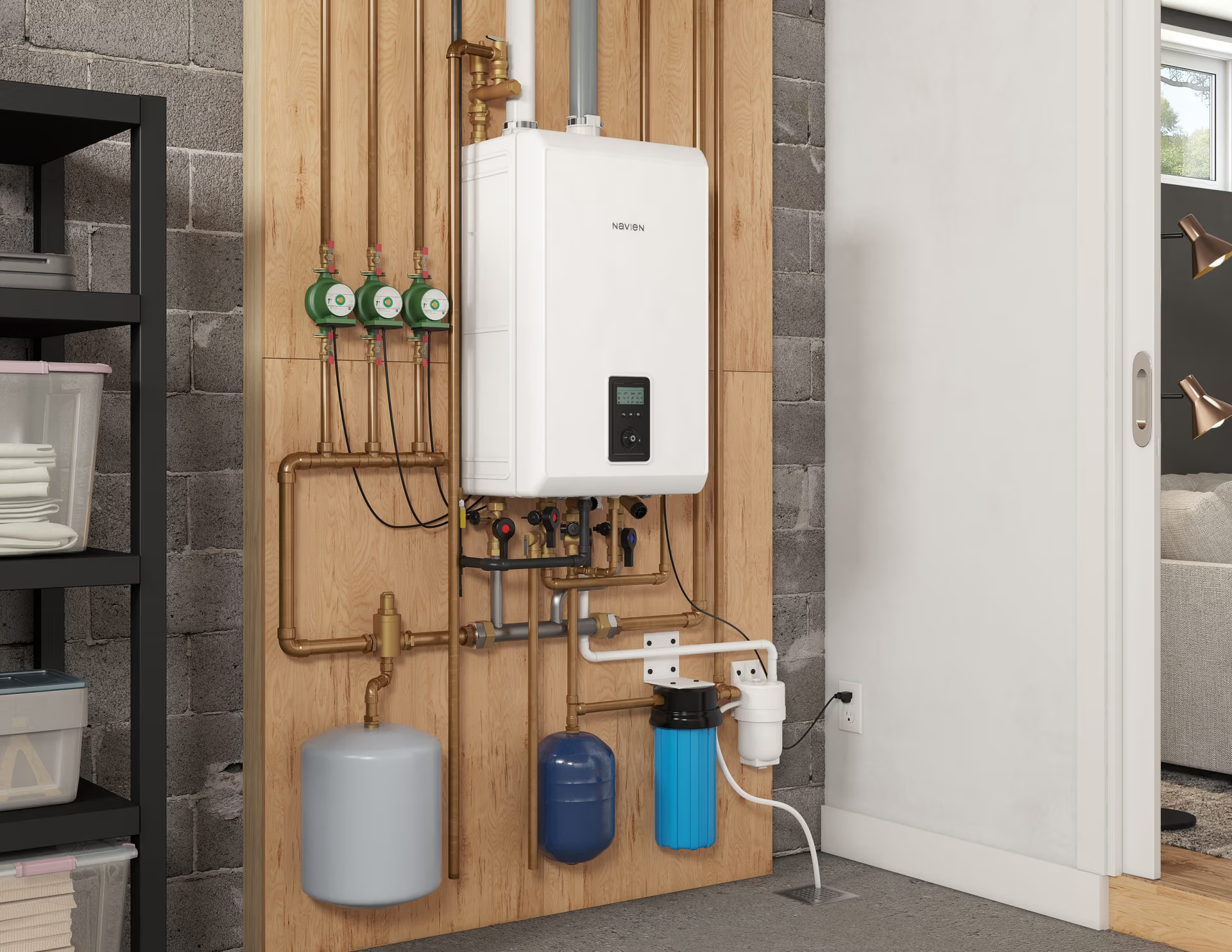
Not every home has ductwork, and not every homeowner wants forced air. If that’s your situation, propane boilers paired with hydronic radiant heating — hot water circulated through in-floor tubing or panel radiators — offer a different kind of warmth that many Canadian homeowners prefer.
Why Radiant Heating Is So Efficient
In-floor tubing operates at low water temperatures (30 to 50°C), compared to 70 to 85°C for baseboard radiators. The lower the return water temperature entering the boiler, the more condensing it can do on the exhaust gases — which pushes efficiency up. In a well-designed radiant system, a condensing propane boiler can match the efficiency of a high-efficiency furnace, with the added benefit of more even heat distribution.
The Comfort Factor
- Even warmth from the floor up — no cold spots, no drafts from registers
- No stratification — warm air stays where you are, not trapped at the ceiling
- Lower thermostat, same comfort — many homeowners set the temperature a degree or two lower without noticing
For homes facing sustained -20°C winters, radiant systems make the interior feel genuinely warmer at the same thermostat setting.
Like any propane combustion system, a boiler delivers full output regardless of outdoor temperature and works independently of the electrical grid. Our equipment installation team can assess whether radiant is the right fit for a new build or a retrofit.
Cold-Climate Heat Pumps: Where They Work and Where They Fall Short
Cold-climate heat pumps from brands like Mitsubishi, Daikin, and Carrier have come a long way. These units can now extract usable heat from outdoor air down to -25°C to -30°C, making them viable in far more Canadian climates than older technology allowed. But “viable” and “sufficient” aren’t the same thing.
The COP Reality Check
At 5°C, a quality cold-climate heat pump delivers COP 2.5 to 3.5 — that’s 2.5 to 3.5 units of heat per unit of electricity. Impressive. But watch what happens as it gets colder:
- At -10°C: COP drops to around 2.0
- At -20°C: COP often falls to 1.2 to 1.7
At those temperatures, the cost advantage over propane narrows considerably — especially in rural Canada, where distribution charges push the effective per-kWh electricity cost well above the generation rate.
Where Heat Pumps Work — and Where They Don’t
Heat pumps work well as a primary system in milder Canadian regions, including:
- Coastal British Columbia
- Southern Ontario (Toronto, Hamilton, Kingston)
- Parts of southern Quebec where sustained temperatures below -20°C are infrequent
A heat pump alone is generally not enough in colder regions such as:
- Northern Ontario above the Georgian Bay latitude
- Much of Quebec outside the Montreal metro area
- All of Manitoba, Saskatchewan, and Alberta outside major urban centres
- Most of the Atlantic Canada
If your location regularly sees weeks with overnight lows between -25°C and -40°C, a heat pump without proper backup is not adequate as primary heating.
Comparing the Options: Propane vs. Electric vs. Heating Oil
Most heating comparisons are written for urban homeowners with access to natural gas. If that’s not your situation, your real shortlist comes down to three options: propane, heating oil, and electricity. Here’s how they stack up.
Propane vs. Electric Baseboard
An electric baseboard is 100% thermodynamically efficient — every watt becomes heat. But efficiency on paper doesn’t mean affordable in practice. Ontario’s Time-of-Use pricing charges peak rates during the exact hours when heating demand is highest (mornings and evenings), and rural customers pay distribution charges that push the effective per-kWh cost well above the generation rate.
Bottom line: A high-efficiency propane furnace at 96% AFUE typically delivers heat more cheaply than electric baseboard in rural Canada, especially during peak demand periods.
Propane vs. Heating Oil
- Efficiency: Condensing oil systems top out at 85 to 90% AFUE. Condensing propane furnaces reach 95 to 97%. That 7 to 10 point gap means oil burns significantly more fuel per unit of heat over a full season.
- Cleanliness: Propane burns completely with no soot or combustion deposits. Oil requires annual burner and heat exchanger cleaning to maintain performance.
- Safety and storage: A propane tank is pressurized, sealed, and odorized with mercaptan — any leak is immediately detectable. Oil tanks corrode silently from the inside, with no odorant, and any leak creates soil contamination liability for the homeowner. If you’re currently heating with oil, Avenir Energy’s equipment installation team handles the full conversion from oil tank decommissioning through to propane furnace commissioning.
Propane vs. Heat Pump
This one depends on your climate zone. In areas where -20°C is the low end of winter, a heat pump runs efficiently through most of the season and only needs propane backup for the coldest stretches. Where -30°C or lower is routine, propane does the heavy lifting and the heat pump is most useful during milder shoulder-season weather. For most rural Canadian homeowners, the right answer is the hybrid system that uses both.
Quick Comparison
| Feature | Propane Furnace | Electric Baseboard | Heating Oil | Heat Pump (Cold-Climate) |
|---|---|---|---|---|
| Efficiency | 95–97% AFUE | 100% electric-to-heat | 85–90% AFUE | COP 2.5–3.5 at 5°C; drops to 1.2–1.7 at -20°C |
| Output at -30°C | Full rated BTU | Full if grid is up | Full rated BTU | Significantly reduced |
| Works during power outage | Yes, with generator for blower | No | Yes, with generator for blower | No |
| Maintenance | Annual inspection | Minimal | Annual cleaning | Annual inspection |
| Fuel storage risk | Low | None, but grid-dependent | High | None, but grid-dependent |
| Best for | Most rural Canadian homes | Mild climates or supplemental heat | Homes already on oil | Mild zones or hybrid systems |
The Most Efficient Heating System for Rural and Remote Properties
Most heating guides avoid answering this question directly because the honest answer requires acknowledging that natural gas simply isn’t available to most rural Canadian properties. So let’s be clear.
For a rural property without natural gas, the most efficient heating option is a high-efficiency propane furnace or a hybrid propane-heat pump system. No other combination delivers:
- 95%+ AFUE performance
- Full output in extreme cold
- On-site fuel security
- Independence from utility infrastructure
Propane Tank Sizing for Your Home
A 500-gallon tank holds approximately 400 usable gallons (after accounting for the required vapour space). For a well-insulated 2,000 square foot home in Ontario, that covers roughly 2 to 4 months of heating depending on insulation, thermostat setting, and how cold the winter runs. Properties in colder zones or with higher heating loads should consider a 1,000-gallon tank to reduce delivery frequency and avoid running low during an extended cold stretch.
Why Propane Works Best for Cottages and Seasonal Properties
Propane has a unique advantage for properties that sit empty during parts of the year:
- Propane stores indefinitely – no fuel degradation, no treatment needed at spring reopening
- Heating oil degrades in unused tanks – microbial growth and oxidation reduce fuel quality and require cleaning
- An electric baseboard offers no protection if the power is disconnected during winter cold snaps
- A propane system with a low-point thermostat (5°C) provides freeze protection all winter with minimal fuel consumption and zero grid dependency
Avenir Energy offers automatic propane delivery with wireless tank monitoring, so your seasonal property stays protected without you having to manage refills.
How to Choose the Right Heating System for Your Property
Not sure where to start? Here are the five factors that matter most:
1. Your Climate Zone
How many hours per year does your location spend below -15°C? In southern Ontario, coastal BC, and other mild-winter zones, a cold-climate heat pump with propane backup may be ideal. In northern Ontario, Quebec north of the St. Lawrence, or anywhere in the Prairies, propane should carry more of the heating load. Your heating degree days will tell you exactly where that line falls.
2. Fuel Access
No natural gas at the property? Your practical options are propane, heating oil, and electricity — and propane is the strongest primary fuel choice within that shortlist for most rural properties.
3. Existing Infrastructure
Already have forced-air ductwork? A propane furnace is a direct replacement and installation is typically a day’s work.
No ductwork? A propane boiler with radiant in-floor heating is worth the additional investment if you’re doing a new build or major renovation, especially for a home you plan to stay in long-term.
4. Grid Reliability
If your area loses power for more than a few hours per year during severe winter weather, an all-electric system is a significant risk. A propane setup with a modest generator for the blower keeps your home warm through any outage. A hybrid system gives you both efficiency and that continuity.
5. Budget and Payback
A high-efficiency propane furnace has a lower upfront cost and provides excellent efficiency and reliability on its own. A hybrid system costs more to install but captures additional savings during mild weather — and may qualify for provincial rebates on the heat pump component, improving the payback over a 7 to 10 year horizon.
Financing and Lease-to-Own Programs for New Propane Equipment
Upgrading to a high-efficiency propane furnace, boiler, or water heater is an investment, and we offer flexible financing options to manage costs without paying the full amount upfront.
Lease-to-Own Program
The Lease-to-Own program is an alternative to outright financing. Key features include:
- Free installation: No upfront costs to get your new equipment in place
- First 90 days free: No payments for the first three months after installation
- Ongoing service and repairs coverage included in the lease
- Fully transferable: If you sell your property, the lease transfers to the new owner rather than requiring an early buyout on your end
Our installation team runs site assessments based on your specific property conditions and gives you a recommendation for your actual situation. And once your system is in place, our 24PROPLUS plan covers annual maintenance on furnaces, boilers, and water heaters with 24/7 emergency service and priority repairs, so your equipment stays at peak efficiency year after year.
Pro Tip: Switching from furnace oil to propane? Here’s what many homeowners only find out after they cancel: your oil company typically won’t reimburse you for the fuel still sitting in your tank. To avoid paying for oil you never use, time your conversion for when your tank is already running low. And as soon as you’ve locked in an installation date with us, call your oil provider to pause any scheduled fills. On our end, we’ll handle the propane details end to end: tank sizing, placement, and scheduling your first fill to line up with installation day, so you keep heat from day one.
Never Guess When to Order: Wireless Tank Monitoring for Seasonal Properties
For seasonal and remote properties, fuel level management is a recurring question. Is there enough propane to last through the next two weeks? What happens if temperatures drop before you’re back to check?
Avenir Energy includes wireless tank monitoring with automatic delivery accounts. A sensor on your tank sends live level readings to our system around the clock. When your level drops to the reorder threshold, we schedule a delivery before you run out, without any action required on your end. You can also check your level directly through your Avenir online account or the Nee-Vo app on your phone. Before heading to a seasonal property for a long weekend, you can confirm the tank level from your phone rather than arriving to find out on-site that you’re running low.
For properties using propane purely for low-point thermostat freeze protection over winter, the monitoring keeps the system running quietly in the background while the property sits empty. The tank stays topped up and the heat stays on.
Get the Most Efficient Heating System for Your Property
For most Canadian homeowners, the most efficient heating system is either a high-efficiency propane furnace or a hybrid propane-heat pump system. The right choice depends on your climate zone, grid reliability, infrastructure, and budget.
What propane brings to the table that nothing else does:
- Grid-independent on-site fuel storage
- Full rated BTU output at any outdoor temperature
- 95 to 97% AFUE from modern condensing equipment
- Whole-home fuel integration from one tank and one delivery account
If you’re ready for a specific recommendation, find your nearest Avenir branch and request a quote.
Frequently Asked Questions
What is the best heating system for cold climates?
For most Canadian homes, a high-efficiency propane furnace or a hybrid propane-heat pump system delivers the best combination of efficiency, reliability, and cost. A condensing propane furnace operates at 95 to 97% AFUE and produces full-rated output at any temperature, including -30°C and below. A hybrid system adds a cold-climate heat pump that captures additional efficiency during moderate weather, while the propane furnace covers extreme cold and power outages. The right choice depends on your climate zone, grid reliability, and existing infrastructure.
What is the most efficient heating system in Canada?
In terms of raw efficiency, cold-climate heat pumps deliver the highest COP (2.5 to 3.5) during moderate temperatures, meaning they produce 2.5 to 3.5 units of heat per unit of electricity. However, that efficiency drops significantly below -15°C. For year-round efficiency across a full Canadian winter, a hybrid propane-heat pump system offers the best overall performance — the heat pump runs during mild weather when it’s most efficient, and a high-efficiency propane furnace takes over during extreme cold. For rural properties without natural gas, a propane furnace at 95 to 97% AFUE is the most efficient combustion-based option.
Is propane less efficient when cold?
No. Unlike heat pumps, propane furnaces and boilers deliver the same rated AFUE regardless of outdoor temperature. A 96% AFUE propane furnace converts 96% of propane’s energy into usable heat whether it’s -5°C or -35°C outside. This temperature independence is one of propane’s key advantages in cold climates — on the coldest days when heating demand peaks, a propane system delivers consistent output and efficiency. Propane itself also stores reliably in cold conditions with no degradation.
Can a heat pump heat a house at -30°C?
Modern cold-climate heat pumps can technically operate down to approximately -25°C to -30°C, but their efficiency and heating capacity drop significantly at those temperatures. A unit rated at COP 3.5 at 5°C may deliver only COP 1.2 to 1.7 at -20°C. Capacity also drops — a system rated at 36,000 BTU at 5°C may produce only 18,000 to 22,000 BTU at -20°C. For regions where sustained temperatures below -20°C are common, most heating professionals recommend pairing a cold-climate heat pump with a propane furnace backup.
What is a hybrid or dual-fuel heating system?
A hybrid heating system pairs a cold-climate heat pump with a high-efficiency propane furnace, controlled through a single thermostat. Above the balance point (typically -10°C to -15°C), the heat pump runs because it’s more cost-efficient. Below the balance point, the propane furnace takes over because it delivers consistent output regardless of temperature. The system switches automatically. This combination captures the heat pump’s efficiency during moderate weather while maintaining propane’s reliability during extreme cold and power outages.
How do I choose the right heating system for a rural Canadian property?
Start with your climate zone — how many hours per year your location spends below -15°C determines how much work a heat pump can realistically handle. Next, consider grid reliability — if winter power outages are common, an all-electric system is a significant risk. Then factor in existing infrastructure and budget. For most rural Canadian properties, a high-efficiency propane furnace is the strongest single-system option, and a hybrid propane-heat pump system delivers the lowest annual operating costs. Avenir Energy’s installation team can run a site assessment and recommend the right system for your property.
