
Propane Perspectives
Cost of Propane vs Electric Heat in Ontario: What Homeowners Actually Pay
Compare the real cost of propane vs electric heat in Ontario. See how TOU rates, delivery charges, and rural premiums affect your annual heating bill.
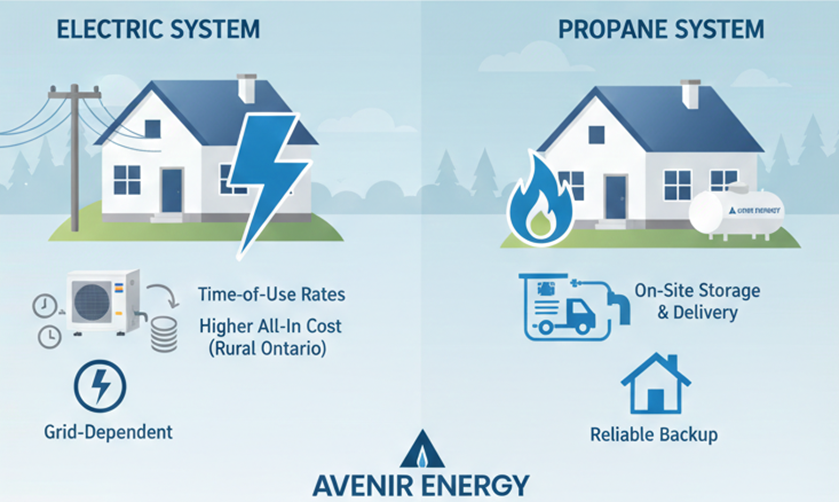
If you heat with propane in Ontario and you’ve wondered whether you’d save money switching to electric, or the other way around, you’ve probably found conflicting answers. That’s because most comparisons leave out the parts that actually matter for residential propane customers: delivery charges, rural rate premiums, and equipment efficiency.
Here’s how the numbers actually work.
The Right Way to Compare Heating Costs
You can’t compare propane and electricity by fuel price alone. The correct comparison accounts for:
- The efficiency of the heating equipment, not just the cost of the fuel going into it
- The all-in electricity rate, not just the commodity rate on your bill
- The reliability of the energy source, because downtime has a cost
- The type of electric heating: baseboard, heat pump, and hybrid systems perform very differently
What Electricity Actually Costs to Heat Your Home in Ontario
The commodity rate on your Ontario bill is only part of what you pay. Understanding the full cost requires looking at all the line items.
Time-of-Use Rates
Ontario residential customers on Time-of-Use (TOU) pricing pay different rates depending on when they use electricity. According to the Ontario Energy Board, on-peak rates (which apply during winter mornings and evenings, when heating demand peaks) are significantly higher than off-peak rates. Electric baseboard heating, which runs on thermostat demand rather than your schedule, concentrates use in the highest-cost periods.
Delivery Charges and Fixed Costs
Your electricity bill includes distribution charges, transmission charges, HST, and various regulatory charges layered on top of the commodity rate. For RPP (Regulated Price Plan) customers on TOU or Tiered pricing, the Ontario Energy Board sets the commodity rate with generation costs already built in. Delivery and regulatory charges then add to that base rate.
As of November 2025, the provincial government also applies a 23.5% Ontario Electricity Rebate (OER) to residential bills, which offsets a portion of the total. Even with the OER, the combined non-commodity charges (delivery, transmission, and regulatory) typically add 6 to 10 cents per kilowatt-hour on top of the commodity price, depending on your consumption level and rate class.
The Rural Premium
Rural Ontario customers on Hydro One’s distribution network face higher delivery charges than urban customers served by municipal utilities. Hydro One does offer a Distribution Rate Protection (DRP) program that caps base distribution charges for eligible rural residential customers, but even with that cap and the 23.5% OER, the effective all-in rate for rural customers heating with electricity typically falls in the range of 18 to 21 cents per kilowatt-hour, varying by usage level and exact location, substantially above the headline commodity rates that most cost comparisons publish.
Propane vs. Electric Baseboard: The Numbers
A typical 2,000 square foot Ontario home heated primarily with electric baseboard might consume 18,000 to 22,000 kWh for space heating over a full heating season. At an all-in effective rate in the range of 18 to 21 cents per kilowatt-hour (accounting for delivery charges, regulatory costs, and the 23.5% OER), that’s roughly $3,240 to $4,620 per heating season.
The same home with a high-efficiency propane furnace (96% AFUE) might consume 2,500 to 3,200 litres of propane for the same heating output. At a residential propane price in the range of $0.70 to $0.95 per litre (reflecting the current Ontario market after the federal carbon charge on propane was eliminated in April 2025), annual heating fuel cost would be approximately $1,750 to $3,040. For most households, that falls well below the electric baseboard equivalent.
The efficiency gap matters: electric baseboard is essentially 100% efficient, but propane at 96% AFUE still wins on cost because the fuel itself delivers far more heat energy per dollar than Ontario electricity at all-in rates.
For most Ontario homeowners heating with electric baseboard, switching to a high-efficiency propane furnace reduces annual heating costs meaningfully. The exact savings depend on home size, insulation quality, propane pricing, and local electricity delivery charges, but a typical range is 20 to 35% based on current rates.
What About a Cold-Climate Heat Pump?
Cold-climate heat pumps have improved significantly, but they’re not the right fit for every rural Ontario property.
Where a Heat Pump Performs Well
A modern cold-climate heat pump can achieve a Coefficient of Performance (COP) of 2.0 to 3.0 in mild winter conditions, meaning it delivers two to three units of heat energy for every unit of electricity it consumes. At those efficiencies, electricity-based heating becomes competitive even at Ontario’s all-in rates. For a home in southern Ontario with relatively mild winters and good grid reliability, a heat pump can reduce heating costs compared to electric baseboard and even approach propane costs in mild years.
Where Heat Pumps Fall Short
The problem is Ontario winters. When outdoor temperatures drop below -15°C to -20°C, which occurs during cold snaps across the province and more frequently in central and northern Ontario, heat pump performance degrades.
A heat pump also depends entirely on the electrical grid. Rural grid outages in Ontario are not rare; they tend to happen during the most severe weather events, when outage duration can stretch from hours to days. A heat pump with no backup heat source in those conditions is a serious problem.
The Hybrid Answer for Most Ontario Homeowners
The most cost-effective approach for many Ontario properties is a hybrid system: a cold-climate heat pump for base-load heating during mild periods, backed by a high-efficiency propane furnace that takes over when temperatures drop, or the grid fails.
- The heat pump handles the majority of heating hours, when outdoor temperatures are moderate and electricity is most cost-competitive
- The propane furnace handles the coldest days: when heat pump COP drops, propane’s predictable cost-per-BTU output takes over
- The propane supply is stored on-site, independent of grid conditions
- Total annual heating costs typically fall below either system operating alone
- The propane furnace also provides a complete, independent backup if the heat pump requires service
This approach is increasingly what we recommend for new construction and major retrofits on rural Ontario properties, and it consistently delivers the best cold-climate heating efficiency for homes outside natural gas service areas.
What Does Propane Heating Actually Cost Per Month in Ontario?
Monthly propane heating costs vary by home size, insulation, thermostat settings, and the specific winter. For a rough planning range:
- A well-insulated home under 1,500 sq ft might average $150 to $250 per month during the heating season with a high-efficiency propane furnace
- A larger home of 2,500 sq ft or more in a colder region might average $300 to $500 per month
These ranges are not guarantees. Propane prices fluctuate with commodity markets, and a colder-than-average winter increases consumption. Budget plans through Avenir Energy can smooth out the seasonal cost variation and make the monthly cash flow more predictable.
Paul M. Ladner, CEO of Avenir Energy, notes: “Electric heating in Ontario carries costs that most homeowners don’t see until the first winter bill hits. Between TOU rates, delivery charges, and the rural premium, electricity ends up costing significantly more per unit of heat than propane. A high-efficiency propane furnace gives you lower annual bills and predictable fuel pricing. For most Ontario homes, that combination makes propane the better investment.”
Heating costs in Ontario are manageable with the right setup. Request a quote to talk through your options and get a delivery plan that fits your home and budget.
Financing and Lease-to-Own Programs for New Propane Equipment
Upgrading to a high-efficiency propane furnace, boiler, or water heater is an investment, and we offer flexible financing options to manage costs without paying the full amount upfront.
Lease-to-Own Program
The Lease-to-Own program is an alternative to outright financing. Key features include:
- Free installation: No upfront costs to get your new equipment in place
- First 90 days free: No payments for the first three months after installation
- Ongoing service and repairs coverage included in the lease
- Fully transferable: If you sell your property, the lease transfers to the new owner rather than requiring an early buyout on your end
Our installation team runs site assessments based on your specific property conditions and gives you a recommendation for your actual situation. And once your system is in place, our 24PROPLUS plan covers annual maintenance on furnaces, boilers, and water heaters with 24/7 emergency service and priority repairs, so your equipment stays at peak efficiency year after year.
Frequently Asked Questions
Is Propane Cheaper Than Electric Heat in Ontario?
In most cases, yes. When you compare a high-efficiency propane furnace against electric baseboard heating at Ontario’s all-in electricity rates, propane typically costs less per unit of heat delivered. The gap is largest in rural areas served by Hydro One, where delivery charges push effective electricity costs significantly higher. A cold-climate heat pump can close the gap in mild weather, but propane remains competitive or cheaper during the coldest periods when heat pump efficiency drops.
How Much Does It Cost to Heat a Home With Propane in Ontario per Month?
A typical range for a well-insulated Ontario home with a high-efficiency propane furnace is $150 to $350 per month during the heating season, depending on home size, local climate, and thermostat settings. Larger homes or older construction with poor insulation can run higher. Many propane customers use budget billing plans to smooth costs across the full year.
What Is the Most Cost-Effective Heating for Rural Ontario?
For most rural Ontario properties without natural gas service, a high-efficiency propane furnace is the most cost-effective primary heating system. A hybrid system pairing a cold-climate heat pump with propane backup can reduce costs further in milder years. Electric baseboard is typically the most expensive option at current Ontario all-in electricity rates.
Is a Heat Pump Cheaper Than Propane in Ontario?
It depends on the winter and the location. During mild stretches, a modern cold-climate heat pump operating at high COP can deliver heat more cheaply than propane. During very cold weather, below -15°C to -20°C, heat pump efficiency drops significantly and the cost advantage narrows or disappears. For rural Ontario properties that experience extended deep cold periods, propane or a propane-backed hybrid system is more predictably cost-effective on a full-season basis.
Why Is Electricity So Expensive in Rural Ontario?
Rural Ontario electricity customers, particularly those on Hydro One’s distribution network, pay higher delivery charges than urban customers because the cost of maintaining distribution infrastructure is spread over fewer customers per kilometre of line. When delivery charges, transmission, and taxes are stacked on top of the commodity rate, the effective all-in cost per kilowatt-hour for rural customers typically falls in the 18 to 21 cent range, substantially higher than the headline commodity rates that most energy comparisons use.
I’m Buying a Home in Rural Ontario With a Propane Heating System — What Should I Know?
First, check the age and condition of the furnace or boiler: a unit over 15 years old may be due for replacement, and upgrading to a 96 or 97% AFUE model when you move in can meaningfully improve efficiency. Confirm the propane tank ownership arrangement. Some tanks are owned by the homeowner and others are rented from the supplier, and that affects your flexibility if you want to change providers. Review the existing propane supply agreement for any term commitments. And get a propane service inspection from a licensed gas fitter before you rely on the system for your first winter. Avenir Energy can set up delivery service and connect you with a certified technician for an inspection.
