
Propane Perspectives
Oil Furnace Replacement: Why Propane Is the Smart Switch
Planning an oil furnace replacement? Learn the costs, steps, and why propane is the top choice for Canadian homeowners switching from oil heat.
How to Tell It’s Time to Switch From Oil to Propane
Oil furnaces don’t usually fail dramatically. They tend to decline — getting less efficient, requiring more frequent repairs, and costing progressively more to run each season. Watch for these signals:-
- Age over 15 to 20 years: most oil furnaces are rated for 15 to 25 years; past that range, efficiency and reliability both decline regardless of maintenance history
- AFUE below 80%: older oil furnaces commonly operate at 65 to 80% AFUE; a replacement high-efficiency propane furnace runs at 96 to 97% AFUE, converting nearly all fuel into usable heat
- Increasing repair frequency: one repair every few years is normal; repairs every season signals the system is past its cost-effective service life
- Rising fuel costs with no explanation: if your oil consumption increases year over year without a change in weather or your habits, combustion efficiency is likely declining
- Soot or carbon deposits: visible soot around the furnace or flue indicates incomplete combustion, which means lost fuel and degraded indoor air quality
- Oil supply challenges: rural oil delivery has become less consistent in some regions as suppliers consolidate or exit markets; switching to propane with scheduled delivery and on-site storage eliminates that uncertainty.
- Lack of available service: the number of practising oil burner mechanics are dwindling due to retirement, and colleges are no longer offering courses, meaning that it’s going to become harder and costlier to find a technician to service your oil furnace.
Why Propane Is the Standard Replacement
When an oil furnace reaches end of life, propane is the most common replacement fuel for properties without natural gas service — and for good reasons. The efficiency gain alone justifies the switch. An older oil furnace running at 70% AFUE wastes 30 cents of every dollar of fuel. A high-efficiency propane furnace at 96% AFUE wastes less than 4 cents. For a home spending $3,000 per year on oil, that efficiency difference can translate to meaningful annual savings before even accounting for any difference in fuel cost per BTU. Beyond efficiency, propane offers practical advantages for rural and off-grid properties:- On-site storage: propane is stored in a tank on your property; you’re not dependent on daily delivery or pipeline infrastructure
- Cleaner combustion: propane burns cleaner than oil, producing less soot and carbon buildup in the heat exchanger and flue
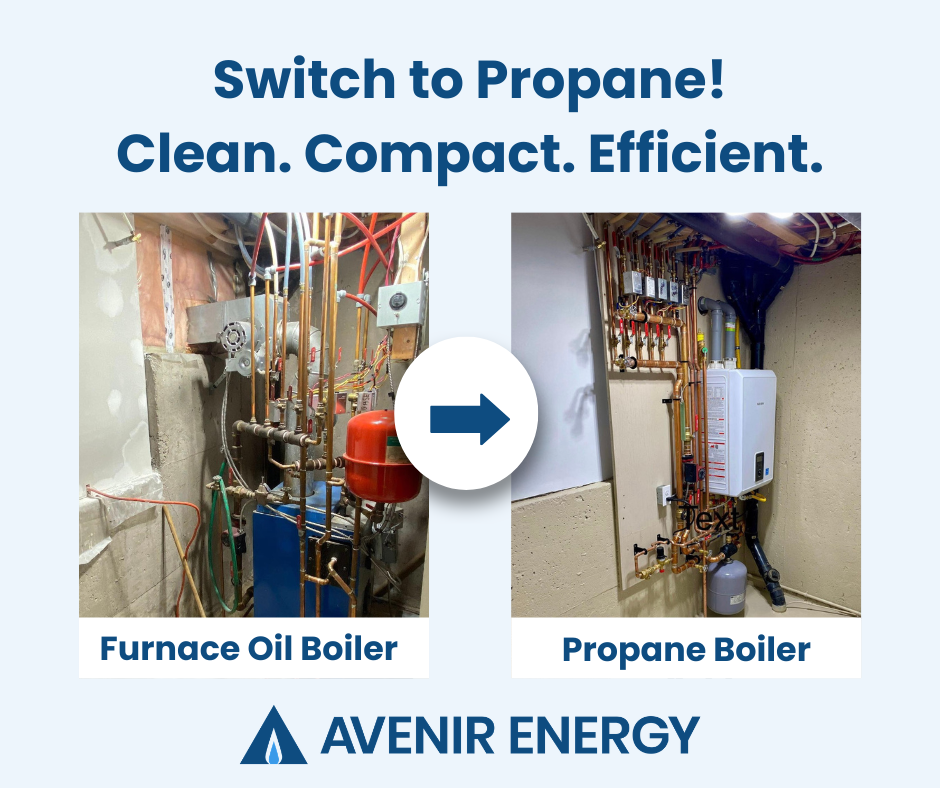
- Smaller equipment footprint: modern propane furnaces are more compact than older oil units, freeing up mechanical room space
- Wider service network: propane appliance technicians are available across virtually every region of Canada
- No oil spill risk: eliminating your oil tank removes the liability and environmental exposure of an aging oil tank.
What Oil-to-Propane Conversion Actually Costs
The total cost of converting from oil to propane covers several components. Each varies based on your home, your province, and the complexity of the installation.New Propane Furnace
A high-efficiency propane furnace (96 to 97% AFUE) for a typical Canadian home typically costs $3,000 to $6,000 installed, depending on the size of the unit, the complexity of the existing ductwork, and local labour rates. If your existing ducts need modification to accommodate the new unit, budget more.Propane Tank
Propane tanks are either rented from the supplier or purchased outright. Rental tanks carry no upfront cost but bind you to the supplier. Purchased tanks cost $1,500 to $3,000 for a standard residential unit but give you full flexibility on supplier choice. We can walk you through the ownership options before any equipment is ordered.Gas Line Installation
A new propane supply line from the tank to the furnace location typically costs $500 to $1,500, depending on distance and whether the line needs to run through a finished basement or crawl space.Oil Tank Decommissioning or Removal
Your existing oil tank cannot simply be abandoned. Depending on its age, condition, and location (above-ground versus buried), decommissioning or removal costs range from $500 to $3,000 or more. Buried tanks that require soil testing add to that range.Permits and Inspections
Most provinces require permits and inspections for gas appliance installations. Budget $200 to $500 for this, and confirm your installer is pulling the required permits — it protects you from liability and ensures the installation is compliant. Total estimated range for a typical conversion: $5,000 to $12,000. Homes with simpler setups, above-ground oil tanks in good condition, and existing propane infrastructure on the property come in at the lower end. Buried tanks, complex duct modifications, or older homes with significant infrastructure work fall toward the upper end.How the Conversion Works, Step by Step
- Home assessment: a certified gas fitter assesses the existing heating system, ductwork, fuel line routing, and oil tank situation
- Propane tank placement: the tank is positioned according to provincial setback requirements and connected to the supply line route
- Oil tank decommissioning: the oil tank is drained, cleaned, and either removed from the property or decommissioned in place (depending on its condition and your province’s requirements)
- Gas line installation: a new propane supply line is run from the tank to the furnace location, properly sized for the BTU demand of the new equipment
- Furnace installation: the old oil furnace is removed; the new propane furnace is installed, connected to the supply line, flue, and existing ductwork
- Commissioning and testing: the system is pressure-tested, the ignition is verified, combustion analysis is performed, and output temperature is confirmed
- Permit inspection: a provincial inspector or authority having jurisdiction reviews the installation before the system goes into service
Your Old Oil Tank: What Happens to It
This is the part of the conversion that surprises the most homeowners — and the part with the most potential for unexpected cost. Oil tanks don’t stay inert when they’re decommissioned. Above-ground steel tanks corrode from the inside out, and residual oil sludge left in an abandoned tank can leak over time. Underground tanks are a more serious issue: a leaking buried oil tank can contaminate surrounding soil and, in some cases, groundwater — creating an environmental liability that falls on the property owner. Each province has its own regulations governing oil tank decommissioning — for example, the TSSA in Ontario, the RBQ in Quebec, and Technical Safety divisions in other provinces. Regardless of where you are, the key requirements are similar:- The tank must be drained of all usable oil and cleaned of sludge
- Above-ground tanks are typically removed from the property
- Buried tanks may be removed or filled with an inert material, depending on condition and provincial rules
- If soil contamination is found during removal, remediation costs are the property owner’s responsibility
We talk to homeowners every week who wish they’d made the switch from oil sooner. Propane gives you higher efficiency, cleaner combustion, and reliable delivery you can actually plan around. Once the new furnace is running and the old oil tank is gone, most people tell us it’s the best upgrade they’ve made to their home. Paul M. Ladner, CEO of Avenir Energy
Life After Switching From Oil Furnace to Propane
- Cleaner operation: no oil odour during burner startup, no soot accumulation on surfaces near the furnace
- More consistent heat distribution: high-efficiency propane furnaces with variable-speed blowers tend to produce more even heat than older oil units
- Quieter equipment: modern propane furnaces operate more quietly than oil-fired systems
- Simpler annual maintenance: propane furnace servicing is typically less involved than oil system maintenance, which includes nozzle cleaning, filter replacement, and combustion adjustment at every visit
- Greater fuel supply confidence: with a scheduled propane delivery plan, your tank stays filled; you’re not watching the oil gauge and hoping the delivery shows up before a cold front
Lease-to-Own Program
The Lease-to-Own program is an alternative to outright financing. Key features include:- Free installation: No upfront costs to get your new equipment in place
- First 90 days free: No payments for the first three months after installation
- Ongoing service and repairs coverage included in the lease
- Fully transferable: If you sell your property, the lease transfers to the new owner rather than requiring an early buyout on your end
