
Perspectives sur le propane
Remplacement de votre fournaise au mazout : pourquoi le propane est le choix judicieux
Vous prévoyez de remplacer votre fournaise au mazout? Découvrez les coûts, les étapes et pourquoi le propane est le choix privilégié des propriétaires canadiens qui abandonnent le chauffage au mazout.
Comment savoir s'il est temps de passer du fioul au propane
Les chaudières au fioul ne tombent généralement pas en panne brutalement. Elles ont tendance à se dégrader progressivement : leur rendement diminue, elles nécessitent des réparations plus fréquentes et leur coût de fonctionnement augmente au fil des saisons. Soyez attentif aux signes suivants :-
- Âge supérieur à 15 ans jusqu'à 20 ans : La plupart des chaudières à mazout ont une durée de vie prévue de 15 à 25 ans ; au-delà, leur efficacité et leur fiabilité diminuent, indépendamment de leur historique d'entretien.
- AFUE inférieur à 80% : Les anciennes chaudières à mazout fonctionnent généralement avec un rendement énergétique annuel (AFUE) de 65 à 80 % ; une chaudière à propane haute efficacité de remplacement fonctionne avec un rendement énergétique annuel (AFUE) de 96 à 97 %, convertissant la quasi-totalité du combustible en chaleur utilisable.
- Augmentation de la fréquence des réparations : Une réparation tous les deux ou trois ans est normale ; des réparations à chaque saison indiquent que le système a dépassé sa durée de vie rentable.
- Hausse inexpliquée des prix du carburant : Si votre consommation de pétrole augmente d'année en année sans changement de météo ni d'habitudes, il est probable que l'efficacité de la combustion soit en baisse.
- Dépôts de suie ou de carbone : La présence visible de suie autour du four ou du conduit de cheminée indique une combustion incomplète, ce qui signifie une perte de combustible et une dégradation de la qualité de l'air intérieur.
- Défis liés à l'approvisionnement en pétrole : Dans certaines régions, la livraison de fioul en zone rurale est devenue moins régulière en raison de la consolidation ou du retrait des fournisseurs du marché ; le passage au propane, avec livraison programmée et stockage sur site, élimine cette incertitude.
- Absence de service disponible : Le nombre de mécaniciens de brûleurs à mazout en activité diminue en raison des départs à la retraite, et les écoles n'offrent plus de cours, ce qui signifie qu'il va devenir plus difficile et plus coûteux de trouver un technicien pour entretenir votre chaudière à mazout.
Pourquoi le propane est le substitut standard
Lorsqu'une chaudière à mazout arrive en fin de vie, le propane est le combustible de remplacement le plus courant pour les propriétés non desservies par le gaz naturel — et ce, pour de bonnes raisons. Le gain d'efficacité à lui seul justifie le changement. Une ancienne chaudière au fioul, avec un rendement AFUE de 701 TPE/3 TPE, gaspille 30 centimes par dollar de combustible. Une chaudière au propane à haut rendement, avec un rendement AFUE de 961 TPE/3 TPE, en gaspille moins de 4 centimes. Pour un foyer dépensant 14 000 $ par an en fioul, cette différence d'efficacité peut se traduire par des économies annuelles substantielles, avant même de prendre en compte toute différence de coût du combustible par BTU. Outre son efficacité, le propane offre des avantages pratiques pour les propriétés rurales et hors réseau :- Stockage sur site : Le propane est stocké dans un réservoir sur votre propriété; vous n'êtes pas dépendant d'une infrastructure de livraison quotidienne ou de pipeline
- Combustion plus propre : Le propane brûle plus proprement que le fioul, produisant moins de suie et d'accumulation de carbone dans l'échangeur de chaleur et le conduit de fumée.
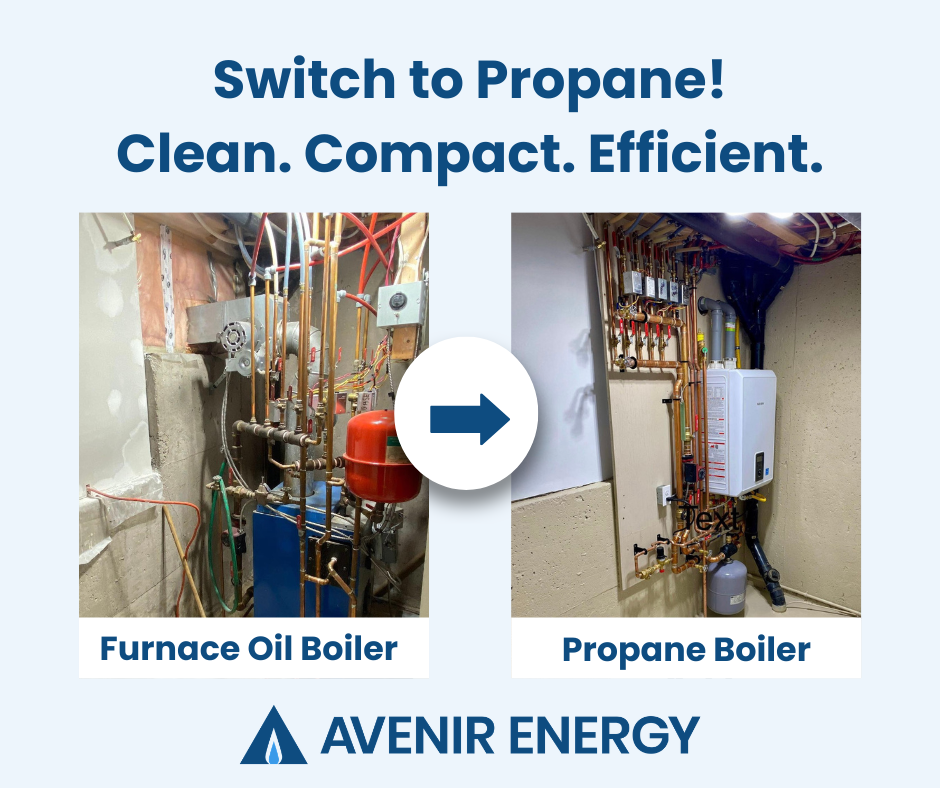
- Encombrement réduit des équipements : Les chaudières au propane modernes sont plus compactes que les anciens modèles au fioul, ce qui libère de l'espace dans le local technique.
- Réseau de service étendu : Des techniciens spécialisés dans les appareils au propane sont disponibles dans pratiquement toutes les régions du Canada.
- Aucun risque de marée noire : La suppression de votre cuve à mazout élimine les responsabilités et les risques environnementaux liés à la vétusté d'une cuve à mazout.
Quel est le coût réel de la conversion du pétrole au propane ?
Le coût total de la conversion du mazout au propane comprend plusieurs éléments. Chacun varie en fonction de votre habitation, de votre province et de la complexité de l'installation.Nouvelle chaudière au propane
Une fournaise au propane à haut rendement (de 96 à 971 TFP) pour une maison canadienne typique coûte généralement entre 14 400 et 14 400 $, installation comprise, selon la taille de l’appareil, la complexité du réseau de conduits existant et le coût de la main-d’œuvre locale. Si vos conduits existants doivent être modifiés pour accueillir la nouvelle fournaise, prévoyez un budget plus important.Réservoir de propane
Les réservoirs de propane peuvent être loués auprès du fournisseur ou achetés. La location ne nécessite aucun frais initial, mais vous engage auprès du fournisseur. L'achat d'un réservoir coûte entre 1 500 et 3 000 TP4T pour une unité résidentielle standard, mais vous offre une totale liberté quant au choix du fournisseur. Nous pouvons vous présenter les différentes options d'acquisition avant toute commande d'équipement.Installation de conduites de gaz
Une nouvelle conduite d'alimentation en propane du réservoir à l'emplacement de la chaudière coûte généralement entre $500 et $1 500, selon la distance et selon que la conduite doit traverser un sous-sol aménagé ou un vide sanitaire.Mise hors service ou retrait des réservoirs de mazout
Votre cuve à fioul existante ne peut être simplement abandonnée. Selon son âge, son état et son emplacement (hors sol ou enterrée), les coûts de mise hors service ou d'enlèvement varient de $500 à $3000, voire plus. Les cuves enterrées, qui nécessitent une analyse du sol, augmentent encore ces coûts.Permis et inspections
La plupart des provinces exigent des permis et des inspections pour l'installation d'appareils à gaz. Prévoyez un budget de $200 à $500 pour ces frais et assurez-vous que votre installateur obtienne les permis requis : cela vous protège contre toute responsabilité et garantit la conformité de l'installation. Plage totale estimée pour une conversion typique : $5 000 à $12 000. Les maisons aux installations plus simples, avec des réservoirs de mazout hors sol en bon état et une infrastructure de propane existante sur la propriété, se situent dans la partie inférieure de la fourchette. Les réservoirs enterrés, les modifications complexes des conduits ou les maisons plus anciennes nécessitant d'importants travaux d'infrastructure se situent dans la partie supérieure.Comment fonctionne la conversion, étape par étape
- Évaluation du domicile : Un installateur de gaz certifié évalue le système de chauffage existant, les conduits, le cheminement des conduites de carburant et la situation du réservoir de mazout
- Emplacement du réservoir de propane : Le réservoir est positionné conformément aux exigences provinciales de recul et raccordé à la conduite d'approvisionnement.
- Mise hors service des réservoirs de pétrole : La cuve à mazout est vidée, nettoyée, puis soit retirée de la propriété, soit mise hors service sur place (selon son état et les exigences de votre province).
- Installation de conduites de gaz : Une nouvelle conduite d'alimentation en propane est installée entre le réservoir et l'emplacement de la chaudière, dimensionnée en fonction de la puissance calorifique requise par le nouvel équipement.
- Installation de la chaudière : L'ancienne chaudière au fioul est retirée ; la nouvelle chaudière au propane est installée et raccordée à la conduite d'alimentation, au conduit de fumée et aux conduits existants.
- Mise en service et essais : Le système est testé sous pression, l'allumage est vérifié, une analyse de combustion est effectuée et la température de sortie est confirmée.
- Inspection des permis : Un inspecteur provincial ou une autorité compétente examine l'installation avant la mise en service du système.
Votre ancienne cuve à fioul : qu'advient-il d'elle ?
C’est cette partie de la rénovation qui surprend le plus les propriétaires — et celle qui présente le plus grand risque de coûts imprévus. Les réservoirs de pétrole ne restent pas inertes une fois mis hors service. Les réservoirs en acier hors sol se corrodent de l'intérieur vers l'extérieur, et les résidus de pétrole laissés dans un réservoir abandonné peuvent fuir avec le temps. Les réservoirs souterrains posent un problème plus grave : une fuite d'un réservoir enterré peut contaminer le sol environnant et, dans certains cas, les eaux souterraines, engendrant ainsi une responsabilité environnementale pour le propriétaire du terrain. Chaque province a ses propres règlements régissant la mise hors service des réservoirs de mazout — par exemple, la TSSA en Ontario, la RBQ au Québec et les divisions de la sécurité technique dans d'autres provinces. Peu importe où vous vous trouvez, les exigences essentielles sont similaires :- Le réservoir doit être vidangé de toute huile utilisable et nettoyé des boues.
- Les réservoirs hors sol sont généralement retirés de la propriété.
- Les réservoirs enterrés peuvent être enlevés ou remplis d'un matériau inerte, selon leur état et la réglementation provinciale.
- Si une contamination du sol est constatée lors de l'enlèvement, les coûts de dépollution sont à la charge du propriétaire.
Chaque semaine, nous discutons avec des propriétaires qui regrettent de ne pas être passés plus tôt au propane. Le propane offre un meilleur rendement, une combustion plus propre et une livraison fiable sur laquelle vous pouvez vous organiser. Une fois la nouvelle chaudière en marche et l'ancienne cuve à fioul enlevée, la plupart des gens nous disent que c'est le meilleur investissement qu'ils aient fait pour leur maison. Paul M. Ladner, PDG d'Avenir Energy
La vie après le passage d'une chaudière au fioul à une chaudière au propane
- Opération de nettoyage : Aucune odeur d'huile au démarrage du brûleur, aucune accumulation de suie sur les surfaces à proximité du four
- Répartition de la chaleur plus homogène : Les chaudières au propane à haut rendement avec ventilateurs à vitesse variable ont tendance à produire une chaleur plus uniforme que les anciennes chaudières au fioul.
- Équipement plus silencieux : Les chaudières au propane modernes fonctionnent plus silencieusement que les systèmes au fioul.
- Maintenance annuelle simplifiée : L'entretien d'une chaudière au propane est généralement moins complexe que celui d'un système au fioul, qui comprend le nettoyage des gicleurs, le remplacement du filtre et le réglage de la combustion à chaque visite.
- Confiance accrue dans l'approvisionnement en carburant : Avec un plan de livraison de propane programmé, votre réservoir reste plein ; vous n’avez plus besoin de surveiller la jauge de fioul ni d’espérer que la livraison arrive avant une vague de froid.
Programme de location-achat
Le programme de location-achat est une alternative au financement direct. Ses principales caractéristiques sont les suivantes :- Installation gratuite : Aucun frais initial pour la mise en place de votre nouvel équipement
- Les 90 premiers jours sont gratuits : Aucun paiement pendant les trois premiers mois suivant l'installation
- Couverture continue des services et des réparations inclus dans le bail
- Entièrement transférable : Si vous vendez votre bien, le bail est transféré au nouvel acquéreur sans que vous ayez à racheter votre bail avant son terme.
