Propane Perspectives
Installing a Propane Tank and Gas Line
Before a propane installation, most homeowners want the same three answers: where the tank can go, what size it needs to be, and how long the job will take. But the details vary based on your property, your appliance’s BTU load, your local code requirements, and how easily a delivery truck can access the tank location.
The First Step in the Propane Installation Process: Site Assessment
The first step is a site visit. This is where every downstream decision – tank placement, sizing, gas line routing, delivery logistics – gets figured out based on your actual property. We’re looking at four things:- Code clearances. Under the CSA B149.1 Natural Gas and Propane Installation Code, standard residential tanks (500 and 1,000 gallons) must be at least 10 feet from any building, property line, and source of ignition. Smaller 118-gallon cylinders can be placed against the house but still require 10 feet of clearance from ignition sources. We identify which spots on your property meet those clearances, then narrow it down based on what makes sense for terrain, soil, and access.
- Delivery truck access. Our drivers need to get a truck within roughly 100 feet of the tank to extend the fill hose safely. Narrow driveways, tight turns, overhanging trees, and weight-limited surfaces all affect where a tank can realistically go. We sort this out on the first visit so it doesn’t become a recurring issue on every refill.
- Underground utilities. Before any trenching for a gas line, you need a utility located from your provincial service. In Ontario, that’s Ontario One Call. Call as soon as your installation is booked – locates take a few business days and work can’t start without them.
- Soil and grade. For underground tanks and buried lines, we’re checking drainage, frost depth, and whether bedrock is close to the surface. Rocky ground or high water tables don’t prevent installation, but they change how we trench and what materials we spec.
Choosing the Right Propane Tank Size
Tank sizing is a function of your BTU load – the combined heat output of every propane appliance running simultaneously at peak demand. The most common mistake is picking a tank size based on what a neighbour has, or what seemed standard. Undersizing means more deliveries, tighter scheduling windows, and the real risk of running low on a cold night when demand is high.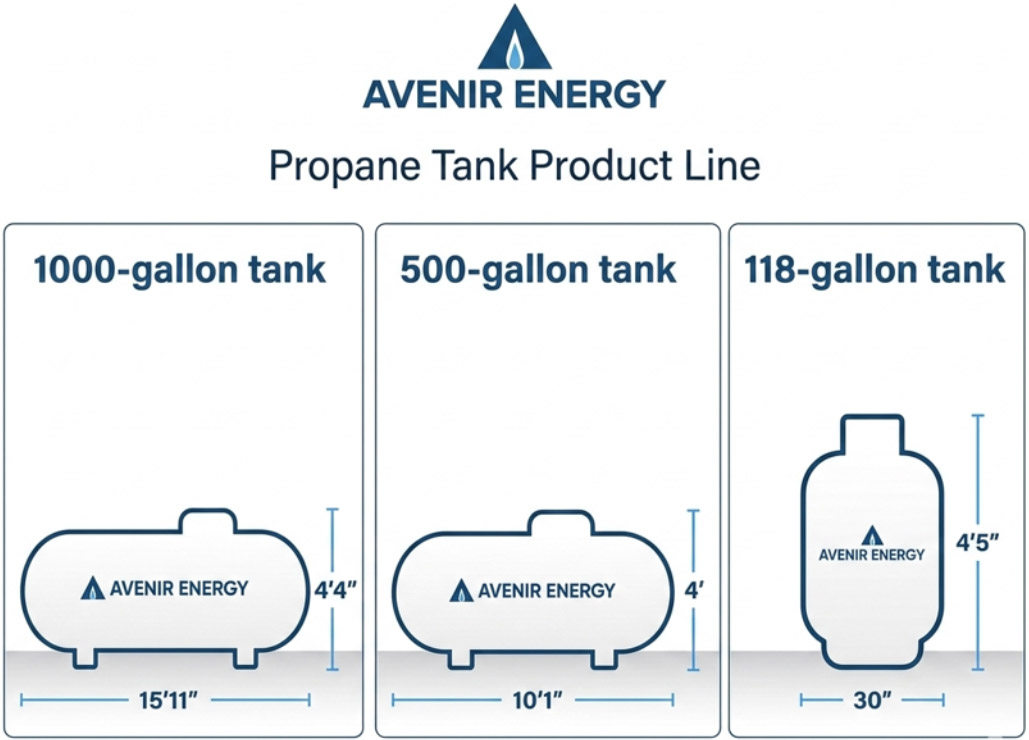
- 118-gallon (363 L usable). 4’5″ high, 30″ in diameter. Right for a water heater and one or two smaller appliances. You can tie up to four of these together against your property, which makes them a practical option when you’re adding propane in phases or when space near the house is limited but a larger single tank isn’t feasible yet.
- 500-gallon (1,514 L usable). 10’1″ long, 4′ high, 38″ in diameter. The standard residential heating tank. If you’re running a furnace or boiler plus a water heater and a couple of other appliances, this is the right fit in most cases. Trenching is required for the gas line run.
- 1,000-gallon (3,028 L usable). Nearly 16 feet long. For large homes, high BTU loads, or properties where all appliances run on propane. The volume gives you more buffer going into winter and fewer deliveries over the season.
Preparing Your Property for Propane Tank Installation
Jobs that run well almost always come down to preparation. Here’s what we need from you before installation day:- Clear the tank location and access path. Remove vehicles, equipment, stored materials, and anything within several feet of where the tank is going. We need clear, level ground and room to set and anchor the tank.
- Get your utility locates done. Call Ontario One Call or BC One Call the moment your installation is booked. Don’t wait. The person doing the digging must initiate the locate — if you’ve hired a contractor for excavation, the contractor is responsible. If you’re doing any digging yourself, you may also need a private locate for privately-owned underground utilities. Locates take a few business days, and trenching cannot proceed without them.
- Check driveway conditions. Soft ground after a spring thaw, ice, a gate that hasn’t opened in two years – these delay jobs. Flag anything like this in advance and we’ll factor it in.
- Have a decision-maker on-site. We need sign-off on the final tank position before we set it permanently, and we do a full system walkthrough before we leave. This can’t be delegated to someone who isn’t familiar with the property.
Installing Propane Gas Line From Tank to House
Once the tank is set, the gas line connects it to your home. This is the part of the installation with the least homeowner visibility, and also the part that determines long-term system performance most directly.How the Propane Line System Works
Residential propane systems use a two-stage pressure reduction process to bring high tank pressure down to appliance-ready levels. The first stage reduces pressure to approximately 10 PSI, and the second stage brings it down to about 11 inches of water column for safe appliance use. On larger homes with longer gas line runs, this is typically done with two separate regulators — one at the tank and one at the house entry. On smaller installations, a single integral two-stage regulator (sometimes called a twin stage or piggyback unit) can handle both reductions in one body mounted at the tank. Either configuration maintains consistent delivery pressure regardless of how full the tank is, how cold it is outside, or how many appliances are running at once.Routing and Safety Considerations
Pipe diameter is calculated based on total BTU load and the length of the run from tank to furthest appliance. Undersize the pipe and you get pressure drop at peak demand – the furnace kicks on, the water heater fires, and the range burner goes soft. Our gas fitters work from your appliance list, not from a rule of thumb. At Avenir Energy, all of our installation work complies with the 2025 edition of CSA B149.1. In Ontario, the TSSA requires us to inspect every installation we complete and re-inspect at least once every 10 years for the life of the system. We track inspection requirements in both provinces so you don’t have to manage them.What Happens on Propane Installation Day
A standard above-ground tank with a single gas line run to the home takes about half a day. Here’s the sequence:- The tank is delivered and set on the prepared pad. We need clear, level ground and room to set the tank on its pad.
- The trench is dug, pipe is run, regulators are connected at both ends, and shutoff valves are set at the tank and at the home’s entry point.
- The entire system is pressure-tested before any gas flows. We’re confirming there are no leaks at fittings, valve bodies, or connection points.
- Appliances are connected, commissioned, and lit. We check every burner – propane should produce a clean, steady blue flame. Yellow or orange flame means incomplete combustion and we don’t sign off until it’s corrected.
- We walk through the system with you before leaving: how to read your gauge, the 30% reorder point, and what to do if you ever smell gas.
Maintaining Your Propane System After Installation
The system itself needs very little from you day to day. Three things matter:If Ordering by Request, Order at 30%, Not Lower
This isn’t an arbitrary threshold – it’s the level that gives us the scheduling window to get a truck to you within 7 to 10 business days, even during peak season. Ordering at 30% means you’ll always have a comfortable buffer while we schedule your next delivery. If you’re on automatic delivery, our wireless monitors handle this for you. If you prefer to manage your own schedule, the Nee-Vo app shows your real-time level without going outside.Clear Your Tank After Heavy Snow
Snow and ice packed around the regulator restricts gas flow and causes pressure fluctuations. After major snowfall, use a broom – never a shovel – to clear the tank, gauges, fittings, lines, and vents. Keep your driveway accessible. We’ve had to turn around on deliveries because a truck couldn’t safely reach the tank.Stay on Top of Maintenance
Our 24PROPLUS service plan covers your primary home heating equipment – furnace, boiler, water heater, fireplace, space heaters – with an annual maintenance visit, 24/7 emergency service in Ontario, New Brunswick, Nova Scotia and PEI, a 15% discount on repairs, and 10% off accessories like thermostats and CO detectors. It’s a flat annual fee that keeps your system looked after without you having to chase it.Safety Tips for Propane Users
Propane is odourless on its own. We add mercaptan – the rotten-egg smell – so leaks are immediately detectable. If you smell it, even faintly, take it seriously. That said, a mercaptan smell doesn’t always mean a leak. When your tank runs very low, the odorant concentrates near the bottom and the smell becomes more noticeable even without a gas escape. If you think your tank may have simply run out, leave the home and call Avenir first – we can check your level remotely and tell you whether it’s an empty tank or something that needs emergency response. Here’s what to do if you’re unsure:- Do not touch light switches, phones, or any appliance. Don’t turn anything on or off.
- Leave the building immediately. Do not stop for belongings.
- If you can safely reach the tank’s handwheel on your way out, turn it clockwise to close the valve. If the smell is strongest near the tank itself, skip this and get clear.
- Once you’re at a safe distance – at least 20 feet – call 911, then call us.
- Do not re-enter until emergency services have cleared the building.
- Call us to have a licensed technician inspect the system and relight your appliances before using them.
Paul M. Ladner, CEO of Avenir Energy, notes: “A propane installation is never just about setting a tank in the yard. At Avenir Energy, we start with a thorough site assessment, plan every detail around provincial requirements, and finish with a fully pressure-tested, commissioned system. Our team handles the entire process, so homeowners across Canada have safe, dependable propane from day one.
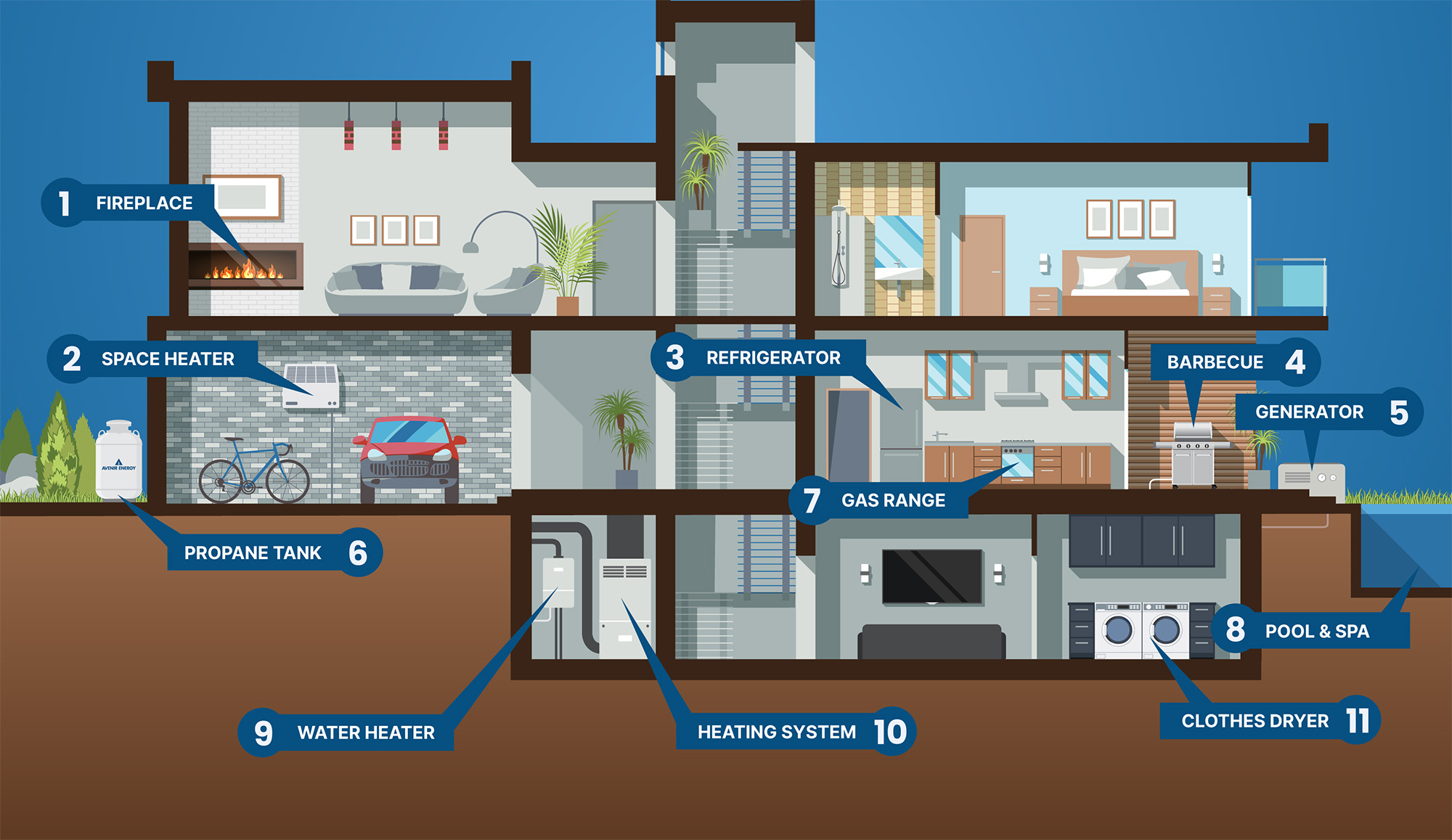
Propane for Whole-Home Use: One Tank Supplying All Major Home Appliances
If you’re building new or doing a full renovation, propane can run every appliance in your home from a single tank. That includes:- Heating systems: furnaces, boilers, radiant in-floor
- Domestic hot water, both tank and tankless
- Cooking: ranges, ovens, cooktops
- Fireplaces and insert units
- Clothes dryers
- Standby generators
- Pool and spa heaters
- Outdoor BBQ hookups