Perspectives sur le propane
Installation d'un réservoir de propane et d'une conduite de gaz
Avant l'installation d'une citerne de propane, la plupart des propriétaires souhaitent obtenir trois réponses : l'emplacement de la citerne, sa capacité et la durée des travaux. Cependant, les détails varient selon la configuration de votre propriété, la puissance calorifique de vos appareils, les réglementations locales et l'accessibilité du site pour un camion de livraison.
Première étape du processus d'installation du propane : évaluation du site
La première étape consiste en une visite du site. C'est à ce moment-là que toutes les décisions relatives aux étapes suivantes – emplacement et dimensionnement de la cuve, tracé de la conduite de gaz, logistique de livraison – sont déterminées en fonction de votre propriété. Nous examinons quatre points :- Autorisations de code. Sous le Code d'installation du gaz naturel et du propane CSA B149.1, Les réservoirs résidentiels standard (500 et 1 000 gallons) doivent être installés à au moins 3 mètres de tout bâtiment, limite de propriété et source d'inflammation. Les réservoirs plus petits, d'une capacité de 450 litres, peuvent être placés contre la maison, mais doivent tout de même respecter une distance minimale de 3 mètres par rapport aux sources d'inflammation. Nous identifions les emplacements sur votre terrain qui répondent à ces exigences, puis nous affinons la sélection en fonction du terrain, du type de sol et de l'accessibilité.
- Accès pour les camions de livraison. Nos chauffeurs doivent positionner le camion à une trentaine de mètres de la cuve pour pouvoir déployer le tuyau de remplissage en toute sécurité. Les allées étroites, les virages serrés, les arbres surplombants et les surfaces où le poids est limité ont tous une incidence sur l'emplacement possible du camion. Nous réglons ce problème dès la première intervention afin qu'il ne se reproduise pas à chaque remplissage.
- Services publics souterrains. Avant de creuser une tranchée pour une conduite de gaz, vous devez localiser le réseau de services publics de votre commune. En Ontario, il s'agit de : Ontario One Call. Appelez-nous dès que votre installation est réservée – la localisation prend quelques jours ouvrables et les travaux ne peuvent pas commencer sans elle.
- Sol et nivellement. Pour les réservoirs souterrains et les canalisations enterrées, nous vérifions le drainage, la profondeur de gel et la proximité du substratum rocheux avec la surface. Un terrain rocheux ou une nappe phréatique élevée n'empêchent pas l'installation, mais modifient la méthode de creusement des tranchées et le choix des matériaux.
Choisir la bonne taille de réservoir de propane
dimensionnement du réservoir La capacité de votre réservoir dépend de votre charge calorifique (en BTU), c'est-à-dire la puissance calorifique cumulée de tous vos appareils au propane fonctionnant simultanément à pleine demande. L'erreur la plus fréquente est de choisir la capacité de son réservoir en fonction de celle de son voisin ou de ce qui semble être la norme. Un réservoir sous-dimensionné entraîne des livraisons plus fréquentes, des créneaux horaires plus restreints et un risque réel de panne sèche par une nuit froide, lorsque la demande est forte.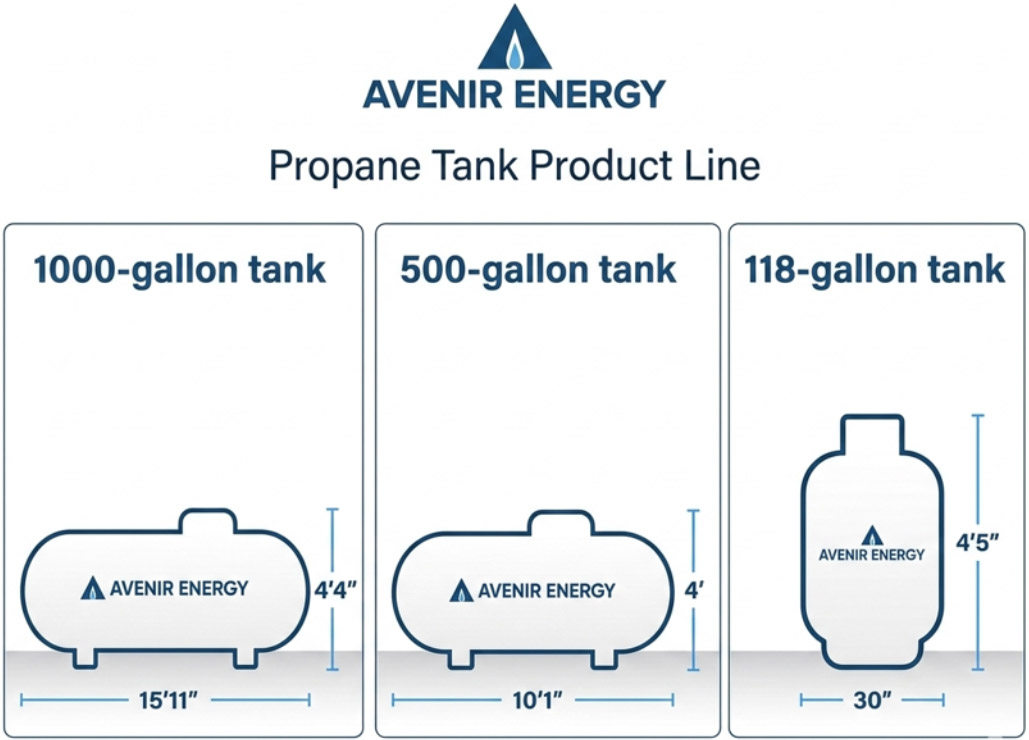
- 118 gallons (363 L utilisables). D'une hauteur de 1,35 m et d'un diamètre de 76 cm, ce réservoir est idéal pour un chauffe-eau et un ou deux petits appareils électroménagers. Vous pouvez en raccorder jusqu'à quatre à votre propriété, ce qui constitue une solution pratique lors d'une installation progressive de propane ou lorsque l'espace près de la maison est limité et qu'une seule grande bonbonne n'est pas encore envisageable.
- 500 gallons (1 514 L utilisables). 3,07 m de long, 1,22 m de haut, 96,5 cm de diamètre. Réservoir de chauffage résidentiel standard. Si vous utilisez une chaudière, un chauffe-eau et quelques autres appareils, ce modèle convient dans la plupart des cas. Le passage de la conduite de gaz nécessite une tranchée.
- 1 000 gallons (3 028 L utilisables). Près de 5 mètres de long. Idéal pour les grandes maisons, les appareils à forte consommation énergétique ou les propriétés où tous les appareils fonctionnent au propane. Ce volume important vous offre une plus grande marge de manœuvre pour l'hiver et réduit le nombre de livraisons pendant la saison.
Préparation de votre propriété pour l'installation d'un réservoir de propane
La réussite d'un projet repose presque toujours sur une bonne préparation. Voici ce dont nous avons besoin de votre part avant le jour de l'installation :- Dégager l'emplacement du réservoir et le chemin d'accès. Veuillez retirer les véhicules, le matériel, les matériaux entreposés et tout ce qui se trouve à quelques mètres de l'emplacement prévu pour la cuve. Nous avons besoin d'un terrain dégagé et plat, ainsi que d'un espace suffisant pour installer et ancrer la cuve.
- Faites réaliser vos localisations de services publics. Appelez Ontario One Call ou BC One Call dès que votre installation est réservée. N'attendez pas. La personne qui effectue les travaux d'excavation doit lancer la recherche de réseaux souterrains. Si vous avez engagé un entrepreneur pour l'excavation, c'est à lui qu'incombe cette responsabilité. Si vous effectuez vous-même les travaux d'excavation, vous pourriez également avoir besoin d'une recherche privée pour les services publics souterrains privés. Les recherches prennent quelques jours ouvrables et les travaux de tranchée ne peuvent commencer sans elles.
- Vérifiez l'état de votre allée. Terrain meuble après la fonte des neiges, verglas, portail inutilisable depuis deux ans : autant de retards possibles. Signalez-nous tout problème de ce genre à l’avance et nous en tiendrons compte.
- Prévoir un décideur sur place. Nous devons obtenir votre accord sur l'emplacement définitif de la cuve avant de la fixer définitivement, et nous effectuons une inspection complète du système avant notre départ. Cette tâche ne peut être déléguée à une personne qui ne connaît pas les lieux.
Installation d'une conduite de gaz propane du réservoir à la maison
Une fois le réservoir installé, la conduite de gaz le raccorde à votre maison. C'est la partie de l'installation la moins visible pour le propriétaire, et pourtant celle qui détermine le plus directement les performances à long terme du système.Fonctionnement du système de conduite de propane
Les systèmes résidentiels au propane utilisent un processus de réduction de pression en deux étapes pour abaisser la pression élevée du réservoir à un niveau compatible avec les appareils. La première étape réduit la pression à environ 10 PSI, et la seconde à environ 11 pouces de colonne d'eau pour une utilisation sûre des appareils. Dans les grandes maisons avec des conduites de gaz plus longues, on utilise généralement deux régulateurs distincts : un au niveau du réservoir et l'autre à l'entrée de la maison. Pour les installations plus petites, un seul régulateur intégré à deux étages (parfois appelé régulateur bi-étagé ou régulateur en tandem) peut gérer les deux réductions de pression dans un seul boîtier monté sur le réservoir. Quelle que soit la configuration, la pression de distribution reste constante, indépendamment du niveau de remplissage du réservoir, de la température extérieure ou du nombre d'appareils en fonctionnement simultané.Considérations relatives à l'itinéraire et à la sécurité
Le diamètre de la conduite est calculé en fonction de la puissance calorifique totale (en BTU) et de la longueur du trajet entre le réservoir et l'appareil le plus éloigné. Un diamètre insuffisant entraîne une chute de pression lors des pics de consommation : le chauffage se met en marche, le chauffe-eau s'allume et le brûleur de la cuisinière faiblit. Nos installateurs de gaz travaillent à partir de la liste de vos appareils, et non selon une règle approximative. Chez Avenir Energy, tous nos travaux d'installation sont conformes aux normes en vigueur. Édition 2025 de la norme CSA B149.1. En Ontario, TSSA Nous sommes tenus d'inspecter chaque installation que nous réalisons et de procéder à une nouvelle inspection au moins une fois tous les 10 ans pendant toute la durée de vie du système. Nous assurons le suivi des exigences d'inspection dans les deux provinces afin que vous n'ayez pas à vous en occuper.Que se passe-t-il le jour de l'installation du propane ?
L'installation d'une citerne hors sol standard, raccordée à la maison par une seule conduite de gaz, prend environ une demi-journée. Voici les étapes :- La cuve est livrée et installée sur la dalle préparée. Nous avons besoin d'un terrain dégagé, plat et suffisamment spacieux pour installer la cuve sur sa dalle.
- La tranchée est creusée, la canalisation est posée, les régulateurs sont raccordés aux deux extrémités et les vannes d'arrêt sont installées au niveau du réservoir et au point d'entrée de la maison.
- L'ensemble du système est testé sous pression avant toute circulation de gaz. Nous vérifions l'absence de fuites au niveau des raccords, des corps de vannes et des points de connexion.
- Les appareils sont raccordés, mis en service et allumés. Nous vérifions chaque brûleur : le propane doit produire une flamme bleue propre et stable. Une flamme jaune ou orange indique une combustion incomplète et nous ne validons la mise en service qu'une fois le problème résolu.
- Avant de partir, nous vous expliquons le fonctionnement du système : comment lire votre jauge, le point de réapprovisionnement du 30% et ce qu'il faut faire si vous sentez une odeur de gaz.
Entretien de votre système au propane après l'installation
Le système lui-même requiert très peu de votre part au quotidien. Trois choses comptent :Si vous commandez sur demande, veuillez indiquer 30%, et non une référence inférieure.
Il ne s'agit pas d'un seuil arbitraire : c'est le niveau qui nous permet de planifier une livraison sous 7 à 10 jours ouvrés, même en haute saison. Commander au 30% vous assure une marge confortable pendant la planification de votre prochaine livraison. Si vous avez opté pour la livraison automatique, nos capteurs sans fil gèrent cela pour vous. Si vous préférez gérer vous-même votre planning, l'application Nee-Vo vous permet de consulter votre niveau de gaz en temps réel, sans avoir à sortir.Vidangez votre réservoir après de fortes chutes de neige.
La neige et la glace accumulées autour du régulateur restreignent le débit de gaz et provoquent des fluctuations de pression. Après d'importantes chutes de neige, utilisez un balai – jamais une pelle – pour dégager le réservoir, les manomètres, les raccords, les conduites et les évents. Assurez-vous que votre allée est accessible. Il nous est arrivé de devoir faire demi-tour lors de livraisons car un camion ne pouvait pas accéder au réservoir en toute sécurité.Assurez-vous de la maintenance.
Notre forfait de service 24PROPLUS Ce forfait annuel couvre vos principaux équipements de chauffage résidentiels (fournaise, chaudière, chauffe-eau, foyer, appareils de chauffage d'appoint) grâce à une visite d'entretien annuelle, un service d'urgence 24 h/24 et 7 j/7 en Ontario, au Nouveau-Brunswick, en Nouvelle-Écosse et à l'Île-du-Prince-Édouard, un rabais de 151 TP3T sur les réparations et un rabais de 101 TP3T sur les accessoires comme les thermostats et les détecteurs de monoxyde de carbone. Il s'agit d'un forfait annuel fixe qui assure l'entretien de votre système sans que vous ayez à vous en soucier.Conseils de sécurité pour les utilisateurs de propane
Le propane est inodore à l'état pur. On y ajoute du mercaptan – responsable de l'odeur d'œuf pourri – afin de détecter immédiatement les fuites. Si vous le sentez, même légèrement, prenez-le au sérieux. Ceci dit, une odeur de mercaptan n'indique pas toujours une fuite. Lorsque le niveau de votre réservoir est presque bas, l'odorant se concentre au fond et l'odeur devient plus perceptible, même en l'absence de fuite de gaz. Si vous pensez que votre réservoir est simplement vide, quittez votre domicile et appelez d'abord Avenir ; nous pouvons vérifier votre niveau à distance et vous indiquer s'il s'agit d'un réservoir vide ou d'une situation nécessitant une intervention d'urgence. Voici la marche à suivre en cas de doute :- Ne touchez ni aux interrupteurs, ni aux téléphones, ni à aucun appareil électroménager. N'allumez ni n'éteignez rien.
- Quittez immédiatement le bâtiment. Ne vous arrêtez pas pour récupérer vos affaires.
- Si vous pouvez atteindre la molette de la cuve en toute sécurité en sortant, tournez-la dans le sens des aiguilles d'une montre pour fermer la vanne. Si l'odeur est plus forte près de la cuve, éloignez-vous et ignorez cette étape.
- Une fois à une distance de sécurité – au moins 6 mètres – appelez le 911, puis appelez-nous.
- Ne rentrez pas dans le bâtiment tant que les services d'urgence ne l'ont pas sécurisé.
- Appelez-nous pour qu'un technicien agréé inspecte le système et rallume vos appareils avant de les utiliser.
Paul M. Ladner, PDG d'Avenir Energy, souligne : “ L'installation d'un système au propane ne se résume jamais à poser une citerne dans la cour. Chez Avenir Energy, nous commençons par une évaluation approfondie du site, nous planifions chaque détail en fonction des exigences provinciales et nous terminons par un système entièrement testé sous pression et mis en service. Notre équipe prend en charge l'ensemble du processus, afin que les propriétaires de partout au Canada bénéficient d'un approvisionnement en propane sûr et fiable dès le premier jour. ».
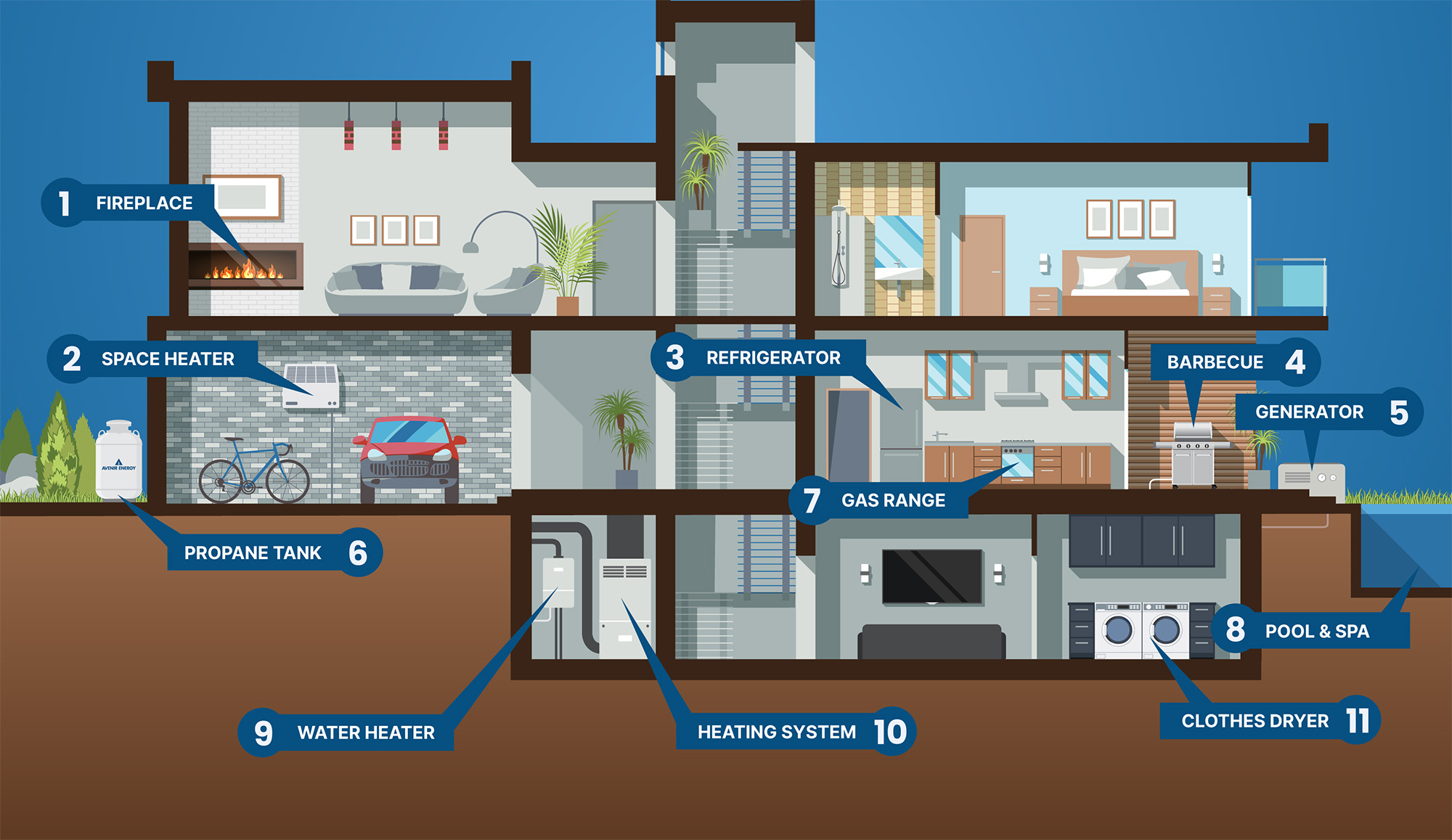
Propane pour toute la maison : une seule bonbonne alimentant tous les principaux appareils électroménagers
Si vous construisez une maison neuve ou si vous effectuez une rénovation complète, le propane peut alimenter tous les appareils de votre maison à partir d'une seule bonbonne. Cela comprend :- Systèmes de chauffage : chaudières, fournaises, planchers chauffants
- Eau chaude sanitaire, avec ou sans réservoir
- Cuisine : cuisinières, fours, plaques de cuisson
- Cheminées et inserts
- Sèche-linge
- Générateurs de secours
- Chauffages de piscine et de spa
- Raccordements pour barbecue extérieur