
Perspectives sur le propane
Système de chauffage le plus efficace pour les climats froids
Comparez les chaudières au propane, les thermopompes et les systèmes hybrides pour les hivers canadiens. Trouvez le plus efficace.
Système de chauffage pour climats froids et propriétés rurales.
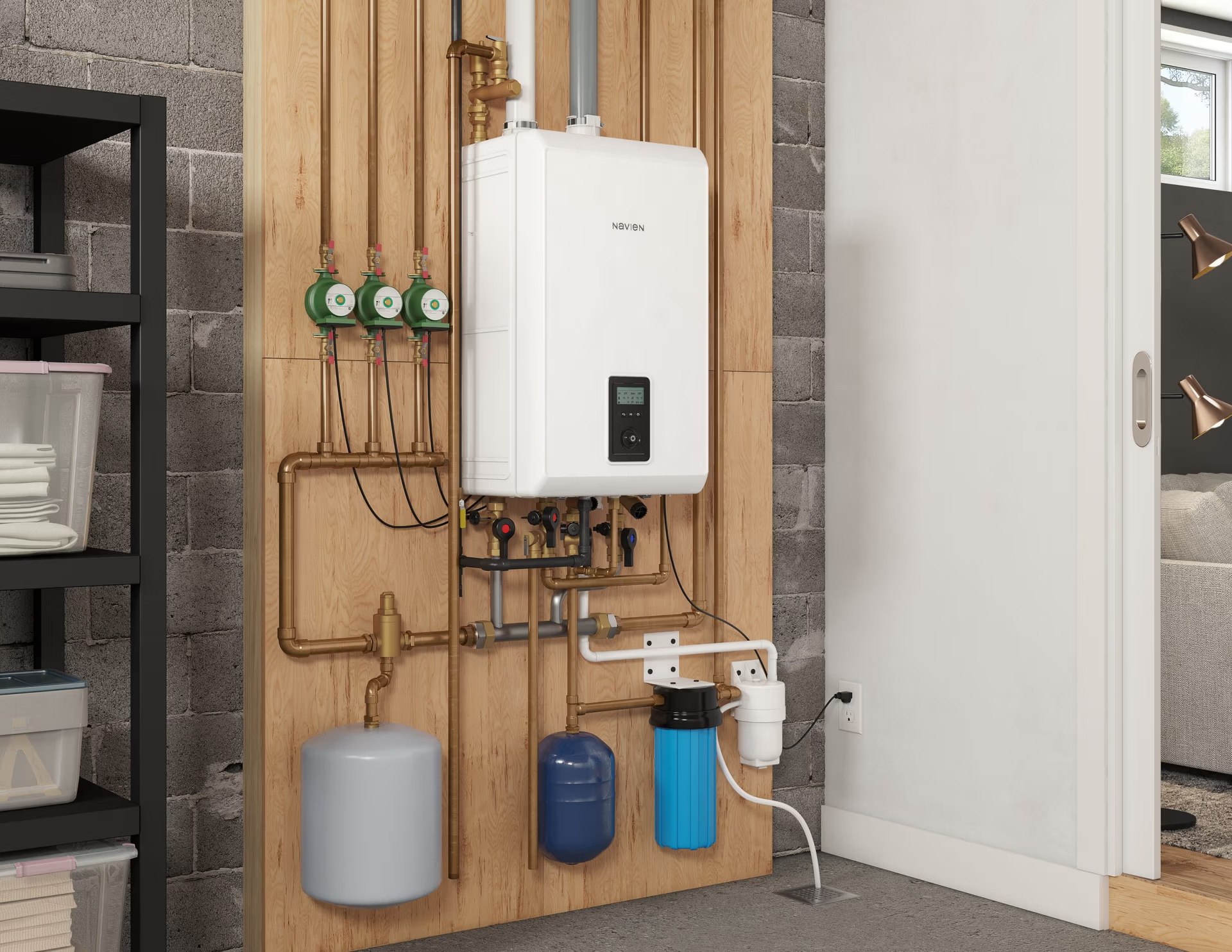
Si vous êtes prêt à explorer les options pour votre propriété, demandez un devis pour notre service résidentiel au propane et découvrez quelle configuration convient le mieux à votre domicile.
Points clés à retenir
- Fournaises au propane à haut rendement (95–97% AFUE) fournir un rendement maximal à n'importe quelle température, y compris à -30 °C et en dessous.
- Le propane est plus performant que les plinthes électriques et le fioul domestique. sur les coûts, l'efficacité et la sécurité d'approvisionnement de nombreuses propriétés rurales canadiennes.
- Un La bonbonne de propane alimente toute votre maison : fournaise, chauffe-eau, cuisinière, réfrigérateur, génératrice et foyer alimentés par une seule source de combustible
- L'indépendance du réseau électrique est importante : Le propane peut maintenir votre maison au chaud pendant les pannes de courant, lorsque les systèmes tout électriques s'arrêtent.
- Toi vous pouvez passer à Avenir Energy à tout moment de l'année, même en plein hiver — demander un devis et notre équipe se chargera de la transition afin que votre maison reste chaude tout au long du processus..
Comment mesure-t-on l'efficacité du chauffage dans les climats froids ?
Avant de comparer les fournaises, les thermopompes ou les systèmes hybrides, il est essentiel de comprendre comment l'efficacité est réellement mesurée, car en hiver canadien, les chiffres figurant sur une fiche technique peuvent être trompeurs.
AFUE : l’unité de mesure des chaudières et des fournaises
L'AFUE (rendement énergétique annuel) indique le pourcentage d'énergie du combustible réellement transformé en chaleur dans votre maison. Une chaudière avec un AFUE de 96% convertit 96 % de chaque dollar de combustible en chaleur et ne perd que 4 % par la cheminée. Un système plus ancien avec un AFUE de 80% gaspille beaucoup plus d'énergie.
Les chaudières à condensation au propane modernes affichent un rendement énergétique annuel (AFUE) de 95 à 971 TPE/3 — équivalent voire supérieur aux meilleurs équipements au gaz naturel. Voici un point essentiel pour les climats froids : L'AFUE ne diminue pas lorsque la température augmente.. Un four à propane à haut rendement fournit le même rendement à -35 °C qu'à -5 °C.
COP : l’indicateur de pompe à chaleur
Les pompes à chaleur utilisent une mesure différente : le COP, ou coefficient de performance. Un COP de 3,0 signifie que le système produit 3 unités de chaleur pour chaque unité d'électricité consommée. C'est impressionnant, mais il y a un hic : Le COP n'est pas un nombre fixe. Elle diminue lorsque les températures extérieures baissent, car une pompe à chaleur fonctionne en puisant la chaleur de l'air extérieur — et il y a tout simplement moins de chaleur à extraire lorsqu'il fait -20 °C.
Un appareil affichant un COP de 3,5 par une douce journée à 5 °C peut n'atteindre qu'un COP de 1,3 à -20 °C. Autrement dit, les jours les plus froids de l'année — précisément lorsque vos besoins en chauffage sont les plus importants — sont ceux où une pompe à chaleur fonctionne le plus intensément pour un rendement minimal.
Le facteur dont personne ne parle : la fiabilité du réseau électrique
Il existe une troisième mesure qui n'apparaît sur aucune fiche technique : Que se passe-t-il en cas de panne de courant ? Un système de chauffage entièrement électrique est particulièrement efficace en cas de panne de courant. Pour les propriétés rurales où les tempêtes hivernales provoquent régulièrement des coupures de courant de 12 à 48 heures, le stockage de combustible sur place fait toute la différence entre une maison chaude et une maison glaciale.
Fournaises au propane à haut rendement pour climats froids
S'il existe un système capable d'affronter un hiver canadien en toute autonomie, c'est bien une fournaise à condensation au propane moderne. Avec un rendement énergétique annuel (AFUE) de 95 à 971 TPE/3 000 tr/min, ces appareils égalent, voire surpassent, les meilleurs équipements au gaz naturel, sans nécessiter de raccordement au réseau. Toute propriété accessible par un camion de livraison d'Avenir Energy est admissible.
Comment fonctionne la technologie de condensation
Une chaudière classique évacue les gaz d'échappement par la cheminée à une température de 180 à 230 °C, emportant avec eux une précieuse chaleur. Une chaudière à condensation, quant à elle, est équipée d'un échangeur de chaleur secondaire qui abaisse la température des gaz de combustion à seulement 40 à 60 °C. À ce stade, la vapeur d'eau contenue dans les gaz d'échappement se condense et libère sa chaleur latente, qui est restituée à votre habitation. C'est cette énergie récupérée qui permet d'atteindre un rendement énergétique annuel (AFUE) supérieur à 80 %.
Puissance maximale à n'importe quelle température
Voici l'avantage crucial par rapport aux pompes à chaleur : Un fourneau au propane fournit sa pleine puissance calorifique nominale (BTU) quelle que soit la température extérieure. Un fourneau de 100 000 BTU/h produit 100 000 BTU, qu'il fasse -5°C ou -30°C à l'extérieur.
Un seul réservoir alimente toute votre maison
Une seule bonbonne de propane peut alimenter :
- Votre fournaise
- chauffe-eau
- Appareils de cuisson et de cuisinière
- Réfrigérateur à propane pour chalets isolés et cuisines rurales
- Générateur de secours
- Foyer encastrable et autres appareils au propane
Un seul calendrier de livraison, un seul compte et un seul fournisseur peuvent simplifier la gestion de l'énergie pour les propriétaires de maisons en milieu rural.
Chaudières au propane et chauffage radiant hydronique
Toutes les maisons ne sont pas équipées de conduits de ventilation, et tous les propriétaires ne souhaitent pas un système de chauffage à air pulsé. Dans ce cas, les chaudières au propane associées à un chauffage radiant hydronique (eau chaude circulant dans des tubes encastrés dans le plancher ou des radiateurs à panneaux) offrent un autre type de chaleur que de nombreux propriétaires canadiens apprécient.
Pourquoi le chauffage radiant est si efficace
Le chauffage au sol fonctionne à basse température (30 à 50 °C), contre 70 à 85 °C pour les radiateurs plinthes. Plus la température de l'eau de retour à la chaudière est basse, plus la condensation des gaz d'échappement est importante, ce qui améliore le rendement. Dans un système de chauffage par le sol bien conçu, une chaudière à condensation au propane peut égaler le rendement d'une chaudière à haut rendement, avec l'avantage supplémentaire d'une répartition de la chaleur plus homogène.
Le facteur confort
- Une chaleur uniforme du sol jusqu'en haut — pas de zones froides, pas de courants d'air provenant des bouches d'aération
- Pas de stratification L'air chaud reste là où vous êtes, et n'est pas emprisonné au plafond.
- Thermostat plus bas, même confort — de nombreux propriétaires baissent la température d'un degré ou deux sans s'en apercevoir.
Pour les maisons confrontées à des hivers rigoureux avec des températures descendant jusqu'à -20°C, les systèmes de chauffage radiant permettent de ressentir une chaleur intérieure plus agréable, à réglage de thermostat égal.
Comme tout système de combustion au propane, une chaudière fournit un rendement maximal quelle que soit la température extérieure et fonctionne indépendamment du réseau électrique. équipe d'installation d'équipement peut évaluer si le traitement radiant convient à une construction neuve ou à une rénovation.
Pompes à chaleur pour climats froids : leurs points forts et leurs limites
Les pompes à chaleur pour climats froids de marques comme Mitsubishi, Daikin et Carrier ont considérablement évolué. Ces appareils peuvent désormais extraire de la chaleur utilisable de l'air extérieur jusqu'à des températures de -25 °C à -30 °C, ce qui les rend utilisables dans un plus grand nombre de climats canadiens que les technologies précédentes. Cependant, “ utilisable ” et “ suffisant ” ne sont pas synonymes.
Vérification des faits concernant la COP
À 5 °C, une pompe à chaleur performante pour climats froids affiche un COP de 2,5 à 3,5, soit 2,5 à 3,5 unités de chaleur par unité d'électricité. Impressionnant. Mais observez ce qui se passe lorsque la température baisse :
- À -10°C : Le COP chute à environ 2,0
- À -20°C : Le COP chute souvent entre 1,2 et 1,7.
À ces températures, l’avantage de coût par rapport au propane se réduit considérablement, surtout dans les régions rurales du Canada, où les frais de distribution font grimper le coût effectif de l’électricité par kWh bien au-dessus du tarif de production.
Où les pompes à chaleur fonctionnent — et où elles ne fonctionnent pas
Les pompes à chaleur fonctionnent bien comme système principal dans les régions canadiennes au climat doux, notamment :
- Côte de la Colombie-Britannique
- Sud de l'Ontario (Toronto, Hamilton, Kingston)
- Certaines parties du sud Québec, où les températures soutenues inférieures à -20 °C sont rares
Une pompe à chaleur seule ne suffit généralement pas dans les régions plus froides telles que :
- Nord de l'Ontario au-dessus de la latitude de la baie Georgienne
- Une grande partie du Québec en dehors de la région métropolitaine de Montréal
- Tout le Manitoba, la Saskatchewan et l'Alberta en dehors des grands centres urbains
- La majeure partie du Canada atlantique
Si votre région connaît régulièrement des semaines avec des températures nocturnes comprises entre -25°C et -40°C, une pompe à chaleur sans système de chauffage d'appoint adéquat n'est pas suffisante comme chauffage principal.
Comparaison des options : propane, électricité ou fioul domestique
La plupart des comparatifs de systèmes de chauffage sont conçus pour les propriétaires de maisons urbaines raccordées au gaz naturel. Si ce n'est pas votre cas, votre choix se limite à trois options : le propane, le fioul et l'électricité. Voici un comparatif.
Plinthes chauffantes au propane ou électriques
Un radiateur électrique de plinthe a un rendement thermodynamique de 100% : chaque watt est transformé en chaleur. Cependant, ce rendement théorique ne se traduit pas par un prix abordable en pratique. En Ontario, la tarification en fonction des heures d'utilisation applique des tarifs de pointe précisément aux heures où la demande de chauffage est la plus forte (matin et soir), et les clients ruraux paient des frais de distribution qui font grimper le coût effectif du kWh bien au-delà du coût de production.
En résumé : Une chaudière au propane à haut rendement de 96% AFUE fournit généralement de la chaleur à moindre coût que les plinthes électriques dans les régions rurales du Canada, surtout pendant les périodes de forte demande.
Propane ou fioul domestique
- Efficacité: Les systèmes de chauffage au fioul à condensation atteignent un rendement énergétique maximal de 85 à 901 TPE/3 T (AFUE). Les chaudières au propane à condensation atteignent quant à elles un rendement de 95 à 971 TPE/3 T. Cet écart de 7 à 10 points signifie que le fioul consomme nettement plus de combustible par unité de chaleur sur une saison complète.
- Propreté: Le propane brûle complètement sans laisser de suie ni de dépôts de combustion. Le fioul nécessite un nettoyage annuel du brûleur et de l'échangeur de chaleur pour maintenir son bon fonctionnement.
- Sécurité et stockage : Une cuve de propane est pressurisée, scellée et odorisée au mercaptan ; toute fuite est donc immédiatement détectable. Les cuves à fioul, quant à elles, se corrodent silencieusement de l'intérieur, sans odeur, et toute fuite expose le propriétaire à des risques de contamination du sol. Si vous utilisez actuellement le fioul pour votre chauffage, l'équipe d'installation d'Avenir Energy prend en charge l'intégralité du processus, de la mise hors service de votre cuve à fioul à la mise en service de votre chaudière au propane.
Propane ou pompe à chaleur
Cela dépend de votre zone climatique. Dans les régions où les températures hivernales descendent généralement jusqu'à -20 °C, une thermopompe fonctionne efficacement pendant la majeure partie de la saison et ne nécessite un apport de propane que lors des périodes de grand froid. Là où les températures descendent régulièrement jusqu'à -30 °C ou moins, le propane assure la majeure partie du chauffage et la thermopompe est surtout utile pendant les intersaisons, lorsque les températures sont plus douces. Pour la plupart des propriétaires de maisons en milieu rural au Canada, la solution idéale est un système hybride qui combine les deux.
Comparaison rapide
| Fonctionnalité | Fournaise au propane | plinthe électrique | Fioul de chauffage | Pompe à chaleur (climat froid) |
|---|---|---|---|---|
| Efficacité | 95–97% AFUE | 100% chauffage électrique | 85–90% AFUE | COP 2,5–3,5 à 5 °C ; chute à 1,2–1,7 à -20 °C |
| Sortie à -30 °C | BTU pleine puissance | Plein si la grille est ouverte | BTU pleine puissance | Réduction significative |
| Fonctionne pendant les pannes de courant | Oui, avec générateur pour le ventilateur | Non | Oui, avec générateur pour le ventilateur | Non |
| Entretien | Inspection annuelle | Minimal | Nettoyage annuel | Inspection annuelle |
| risque lié au stockage du carburant | Faible | Aucun, mais dépendant de la grille | Haut | Aucun, mais dépendant de la grille |
| Idéal pour | La plupart des maisons rurales canadiennes | Climats doux ou chauffage d'appoint | Maisons déjà alimentées au pétrole | Zones tempérées ou systèmes hybrides |
Le système de chauffage le plus efficace pour les propriétés rurales et isolées
La plupart des guides sur le chauffage évitent de répondre directement à cette question, car une réponse honnête implique de reconnaître que le gaz naturel n'est tout simplement pas accessible à la plupart des propriétés rurales canadiennes. Soyons clairs.
Pour une propriété rurale sans gaz naturel, l'option de chauffage la plus efficace est un fournaise au propane à haut rendement ou un système hybride propane-pompe à chaleur. Aucune autre combinaison n'offre les mêmes résultats :
- Performances AFUE du 95%+
- Puissance maximale par grand froid
- Sécurité du carburant sur site
- Indépendance vis-à-vis des infrastructures de services publics
Dimensionnement du réservoir de propane pour votre maison
Un réservoir de 500 gallons contient environ 400 gallons utilisables (après prise en compte de l'espace de vapeur requis). Pour une maison de 2 000 pieds carrés bien isolée en Ontario, cela couvre environ 2 à 4 mois de chauffage, selon l'isolation, le réglage du thermostat et la rigueur de l'hiver. Les propriétés situées dans des zones plus froides ou ayant des besoins de chauffage plus importants devraient envisager un réservoir plus grand. Réservoir de 1 000 gallons pour réduire la fréquence des livraisons et éviter les ruptures de stock pendant une période de froid prolongée.
Pourquoi le propane est la meilleure solution pour les chalets et les propriétés saisonnières
Le propane présente un avantage unique pour les propriétés qui restent inoccupées pendant certaines périodes de l'année :
- Les réserves de propane sont indéfinies – aucune dégradation du carburant, aucun traitement nécessaire lors de la réouverture printanière
- Le fioul domestique se dégrade dans les réservoirs inutilisés. – La prolifération microbienne et l'oxydation réduisent la qualité du carburant et nécessitent un nettoyage
- Une plinthe électrique n'offre aucune protection si l'alimentation électrique est coupée pendant les vagues de froid hivernales
- Un système au propane avec thermostat à point bas (5°C) assure une protection contre le gel tout l'hiver avec une consommation de carburant minimale et une dépendance totale au réseau électrique.
Avenir Energy propose livraison automatique de propane Grâce à la surveillance sans fil des réservoirs, votre propriété saisonnière reste protégée sans que vous ayez à gérer les remplissages.
Comment choisir le bon système de chauffage pour votre propriété
Vous ne savez pas par où commencer ? Voici les cinq facteurs les plus importants :
1. Votre zone climatique
Combien d'heures par an votre région passe-t-elle sous les -15 °C ? Dans le sud de l'Ontario, sur la côte de la Colombie-Britannique et dans d'autres régions à hiver doux, une thermopompe pour climat froid avec chauffage d'appoint au propane pourrait être idéale. Dans le nord de l'Ontario, au nord du Saint-Laurent au Québec, ou partout dans les Prairies, le propane devrait couvrir une plus grande partie des besoins en chauffage. degrés-jours de chauffage vous indiquera précisément où se situe cette ligne.
2. Accès au carburant
Pas de gaz naturel sur la propriété ? Vos options pratiques sont le propane, le fioul et l’électricité — et le propane est le combustible principal le plus performant de cette liste pour la plupart des propriétés rurales.
3. Infrastructures existantes
Vous avez déjà un système de conduits d'air pulsé ? Une chaudière au propane s'y substitue directement et son installation ne prend généralement qu'une journée.
Pas de conduits d'aération ? Une chaudière au propane avec chauffage radiant au sol vaut l'investissement supplémentaire si vous faites une construction neuve ou une rénovation majeure, surtout pour une maison dans laquelle vous prévoyez de rester à long terme.
4. Fiabilité du réseau
Si votre région subit des coupures de courant de plus de quelques heures par an lors d'intempéries hivernales, un système entièrement électrique représente un risque important. Un système au propane, associé à un petit générateur pour le ventilateur, permet de maintenir votre maison au chaud même en cas de panne de courant. Un système hybride offre à la fois efficacité et performance. et cette continuité.
5. Budget et retour sur investissement
Une fournaise au propane à haut rendement coûte moins cher à l'achat et offre une excellente efficacité et fiabilité. Un système hybride est plus coûteux à installer, mais permet de réaliser des économies supplémentaires par temps doux et peut donner droit à des rabais provinciaux sur la thermopompe, ce qui améliore le retour sur investissement sur une période de 7 à 10 ans.
Programmes de financement et de location-achat pour les nouveaux équipements au propane
L’installation d’une chaudière, d’un chauffe-eau ou d’une fournaise au propane à haut rendement est un investissement, et nous offrons des options de financement flexibles pour gérer les coûts sans avoir à payer la totalité du montant d’avance.
Programme de location-achat
Le programme de location-achat est une alternative au financement direct. Ses principales caractéristiques sont les suivantes :
- Installation gratuite : Aucun frais initial pour la mise en place de votre nouvel équipement
- Les 90 premiers jours sont gratuits : Aucun paiement pendant les trois premiers mois suivant l'installation
- Couverture continue des services et des réparations inclus dans le bail
- Entièrement transférable : Si vous vendez votre bien, le bail est transféré au nouvel acquéreur sans que vous ayez à racheter votre bail avant son terme.
Notre équipe d'installation effectue des évaluations sur site en fonction des spécificités de votre propriété et vous fournit une recommandation adaptée à votre situation. Une fois votre système installé, notre Plan 24PROPLUS Elle couvre l'entretien annuel des chaudières, des chauffe-eau et des fournaises avec un service d'urgence 24h/24 et 7j/7 et des réparations prioritaires, afin que votre équipement conserve une efficacité maximale année après année.
Conseil de pro : Vous envisagez de passer du fioul au propane ? Voici ce que de nombreux propriétaires découvrent seulement maintenant. après En cas d'annulation, votre fournisseur de fioul ne vous remboursera généralement pas le fioul restant dans votre cuve. Pour éviter de payer du fioul que vous n'utilisez jamais, planifiez votre conversion au propane lorsque votre cuve est presque vide. Dès que vous aurez confirmé la date d'installation avec nous, contactez votre fournisseur de fioul pour suspendre les remplissages programmés. De notre côté, nous nous occupons de tout concernant le propane : dimensionnement et emplacement de la cuve, et planification de votre premier remplissage pour qu'il coïncide avec le jour de l'installation, afin que vous bénéficiiez de chauffage dès le premier jour.
Ne vous demandez plus quand commander : système de surveillance sans fil des réservoirs pour les propriétés saisonnières
Pour les propriétés saisonnières et isolées, la gestion des réserves de combustible est une question récurrente. Y a-t-il assez de propane pour tenir les deux prochaines semaines ? Que se passe-t-il si les températures chutent avant votre retour pour vérifier ?
Avenir Energy propose un service de surveillance sans fil des cuves avec livraison automatique. Un capteur installé sur votre cuve transmet en continu les niveaux de niveau à notre système. Lorsque votre niveau atteint le seuil de réapprovisionnement, nous programmons une livraison avant que vous ne soyez à court de carburant, sans aucune intervention de votre part. Vous pouvez également consulter votre niveau directement depuis votre compte. Compte en ligne Avenir ou l'application Nee-Vo sur votre téléphone. Avant de partir pour une résidence secondaire le temps d'un long week-end, vous pouvez vérifier le niveau de la cuve depuis votre téléphone plutôt que de constater sur place qu'elle est presque vide.
Pour les propriétés utilisant le propane uniquement pour la protection contre le gel du thermostat basse température pendant l'hiver, le système de surveillance assure un fonctionnement discret en arrière-plan lorsque la propriété est inoccupée. La cuve reste pleine et le chauffage reste allumé.
Obtenez le système de chauffage le plus efficace pour votre propriété
Pour la plupart des propriétaires canadiens, le système de chauffage le plus efficace est soit une fournaise au propane à haut rendement, soit un système hybride propane-pompe à chaleur. Le choix optimal dépend de votre zone climatique, de la fiabilité du réseau électrique, des infrastructures et de votre budget.
Ce que le propane apporte que rien d'autre n'offre :
- Indépendant du réseau stockage de carburant sur site
- Puissance calorifique nominale maximale à n'importe quelle température extérieure
- 95 à 97% AFUE à partir d'équipements de condensation modernes
- Intégration du combustible dans toute la maison à partir d'un compte de réservoir et de livraison
Si vous êtes prêt pour une recommandation spécifique, Trouvez votre succursale Avenir la plus proche. et demandez un devis.
Foire aux questions
Quel est le meilleur système de chauffage pour les climats froids ?
Pour la plupart des foyers canadiens, une fournaise au propane à haut rendement ou un système hybride propane-pompe à chaleur offre le meilleur compromis entre efficacité, fiabilité et coût. Une fournaise au propane à condensation fonctionne avec un rendement énergétique annuel (AFUE) de 95 à 971 % et produit sa pleine puissance nominale à toutes les températures, même -30 °C et moins. Un système hybride comprend une pompe à chaleur pour climats froids qui optimise le rendement par temps doux, tandis que la fournaise au propane prend le relais en cas de grand froid et de panne de courant. Le choix le plus approprié dépend de votre zone climatique, de la fiabilité du réseau électrique et de l'infrastructure existante..
Quel est le système de chauffage le plus efficace au Canada ?
En termes d'efficacité brute, les thermopompes pour climats froids offrent le COP le plus élevé (2,5 à 3,5) par temps doux, ce qui signifie qu'elles produisent de 2,5 à 3,5 unités de chaleur par unité d'électricité. Cependant, leur efficacité chute considérablement en dessous de -15 °C. Pour une efficacité optimale tout au long de l'hiver canadien, un système hybride thermopompe-propane offre la meilleure performance globale : la thermopompe fonctionne par temps doux, lorsqu'elle est la plus efficace, et une fournaise au propane à haut rendement prend le relais par grand froid. Pour les propriétés rurales non raccordées au gaz naturel, une fournaise au propane avec un rendement AFUE de 95 à 971 TP3T est l'option de combustion la plus efficace.
Le propane est-il moins efficace par temps froid ?
Non. Contrairement aux pompes à chaleur, les chaudières et les fournaises au propane offrent le même rendement énergétique nominal (AFUE) quelle que soit la température extérieure. Une fournaise au propane de 96% AFUE convertit 96% d'énergie du propane en chaleur utilisable, qu'il fasse -5 °C ou -35 °C à l'extérieur. Cette indépendance vis-à-vis de la température est l'un des principaux avantages du propane dans les régions froides : même par temps très froid, lorsque la demande de chauffage est à son maximum, un système au propane garantit une puissance et une efficacité constantes. Le propane se stocke également de manière fiable par temps froid sans se dégrader.
Une pompe à chaleur peut-elle chauffer une maison à -30°C ?
Les pompes à chaleur modernes pour climats froids peuvent techniquement fonctionner jusqu'à environ -25 °C à -30 °C, mais leur rendement et leur puissance de chauffage diminuent considérablement à ces températures. Un appareil avec un COP de 3,5 à 5 °C peut n'atteindre qu'un COP de 1,2 à 1,7 à -20 °C. La puissance diminue également : un système d'une puissance de 36 000 BTU à 5 °C peut ne produire que 18 000 à 22 000 BTU à -20 °C. Dans les régions où les températures inférieures à -20 °C sont fréquentes et prolongées, la plupart des chauffagistes recommandent d'associer une pompe à chaleur pour climats froids à une chaudière à propane d'appoint.
Qu'est-ce qu'un système de chauffage hybride ou à double combustible ?
Un système de chauffage hybride associe une pompe à chaleur adaptée aux climats froids à une chaudière au propane à haut rendement, le tout étant contrôlé par un thermostat unique. Au-dessus du point d'équilibre (généralement entre -10 °C et -15 °C), la pompe à chaleur fonctionne car elle est plus économique. En dessous de ce point d'équilibre, la chaudière au propane prend le relais car elle fournit une puissance constante quelle que soit la température. Le système bascule automatiquement entre les deux. Cette combinaison permet de tirer parti de l'efficacité de la pompe à chaleur par temps doux tout en conservant la fiabilité du propane en cas de grand froid ou de coupure de courant.
Comment choisir le système de chauffage adapté à une propriété rurale canadienne ?
Commencez par déterminer votre zone climatique : le nombre d’heures par an où la température descend en dessous de -15 °C détermine la capacité réelle d’une thermopompe. Ensuite, tenez compte de la fiabilité du réseau électrique : si les pannes de courant hivernales sont fréquentes, un système entièrement électrique présente un risque important. Enfin, considérez l’infrastructure existante et votre budget. Pour la plupart des propriétés rurales canadiennes, une fournaise au propane à haut rendement est la solution la plus performante, et un système hybride propane-thermopompe offre les coûts d’exploitation annuels les plus bas. L’équipe d’installation d’Avenir Energy peut effectuer une évaluation sur place et vous recommander le système le mieux adapté à votre propriété.
